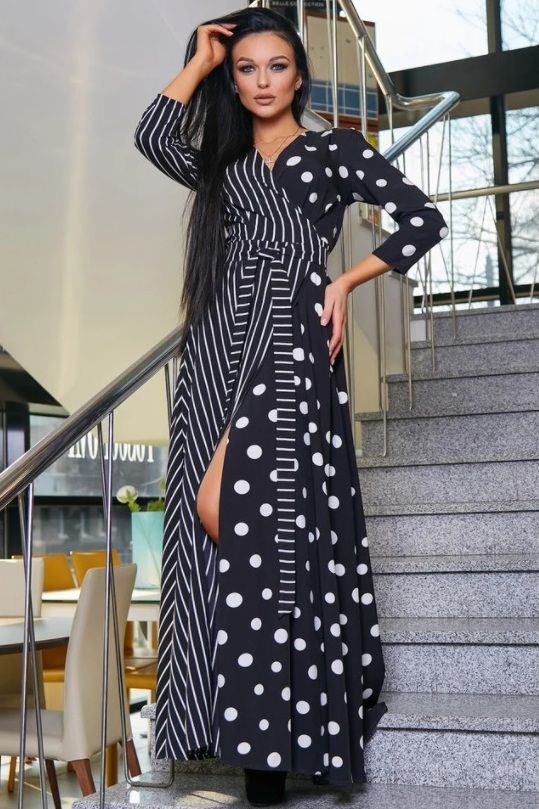
Polka dot print — when should you adjust the pattern?
What could be sweeter than polka dots that never go out of style? 😍 Very feminine, slightly retro and always in style 😉
Now I'll tell you about the trickiness of this print 😀 Experienced makers probably already know, but this info will be useful for beginners: forewarned = forearmed.
First — when can you expect no surprises and cut without pattern matching?
- small (1,5 cm in diameter and smaller) polka dots don't require pattern matching, nor do prints that are too dense/too sparse

- polka dots of varying sizes on the same garment also don't suffer from lack of strict order: they're beautiful in their chaos ))

- if the dress has frequent ruffles, draping, ribbon trim, or if the print is 'scattered' asymmetrically, you also won't need to match the pattern

That's where the bonuses end 😛 The moment comes when you'll need to buy extra fabric to have plenty to play with when matching the print.
- make sure that at the seam line between front/back pieces the polka dot is split into equal halves, not into offset pieces — that visually distorts the figure

- when cutting the front piece, it's worth checking in advance whether the dots will fall exactly on the points of the bust — such 'decoration' looks rather peculiar 🙃

- if a dress has a deep narrow neckline or slit that runs through the print, the polka dots should be 'split' symmetrically. For clarity — in the photo it's the same dress, but one of them is cut with pattern matching (left), while the other apparently wasn't fussed over )

- another point: a dot landing on a dart area can break the shape of the print (see the bust dart in the photo). Also a dot ending up in the underarm area is a rather awkward situation 😅

And the final trick of the polka dot print: for full-figured beauties, large prints are generally not recommended — only small ones.

If all-over polka dots are too boring for you and you don't want to spend a lot of time matching, choose a mixed print. It always looks original! 👍