
How to avoid fabric distortion when sewing
If you sew a lot for yourself or for clients, you have likely encountered this problem: the garment is cut correctly, but the seams start to twist during the fitting. This can happen if the fabric was distorted and not corrected before cutting. What does this look like in a real-world example?
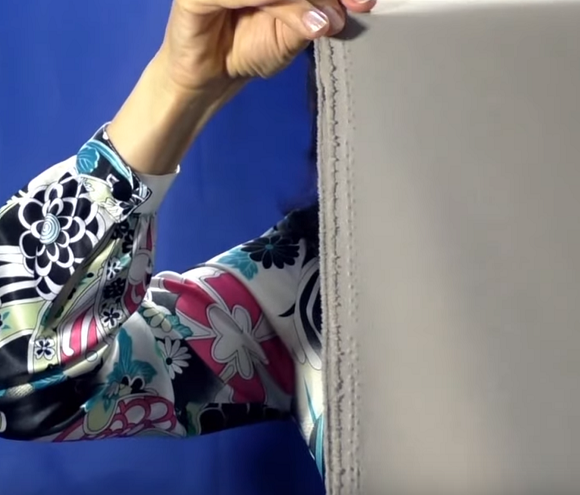
If you fold the fabric and look at it horizontally, the distortions may be barely noticeable. Therefore, any fabric should be folded and examined vertically before you start working with it. The most common defect is a skew toward the selvage, where the two halves pull in opposite directions.
## Why does this happen?
Elastic fabric often stretches if it is torn from the roll. It is also possible that the distortion was caused by a shop assistant, and all subsequent cuts, even those made with scissors, resulted in an uneven edge. That is why, when accepting an order, you should always perform a quick test and check the material in good lighting for small defects and spots.
## How to fix the distortion?
To do this, you need to fold the material by strictly aligning the selvage and laying it out on a flat horizontal surface. Then, place a square ruler against the selvage and draw a straight line.

After leaving a few centimeters from the edge, you can start laying out your pattern.

## What to do if striped or plaid fabric is distorted?
This is a very common problem, and it can be noticeable even on a small piece of fabric.

It is especially difficult if the fabric is "fluid," such as silk or viscose. In this case, the distortion can be toward the selvage or toward the center of the fabric. The initial preparation is similar to the method described above. You need to apply a ruler and mark a straight line.

However, another issue may arise: the new line does not align with the stripes or plaid.

You cannot simply cut the edge and align the pattern to it; the only solution is to use the grainline stripes as a guide, which should be laid out flat rather than folded in half.

If plaid fabric is unstable, it is best not to use it for form-fitting garments or blouses with a straight front closure. It is better to choose a bias-cut skirt or semi-fitted clothing with a shaped hem.


Very useful information! I ran into the same thing when buying tulle from a roll (I planned to sew it myself, as I wanted to make a dense gather and save some money along the way, since such tulle is expensive ready-made here). And what do we have? A 30 cm skew! Thirty, Karl! They must have torn the fabric; more precisely, it's obvious - there is no clean cut. It's too late to complain - it was an online order from Prom.ua, and shipping it back and wasting nerves on disputes would cost more than it's worth. It's a Show full quoteCollapse