
How to transfer patterns to fabric? A review of tailor's chalks.
I recently decided to sort through my tools and discovered I have a million different types of chalk. This gave me the idea to write about how to transfer patterns to fabric and which materials work best for marking different types of fabric. I'm sharing my own experience and accessible materials (I don't spend a fortune on them).
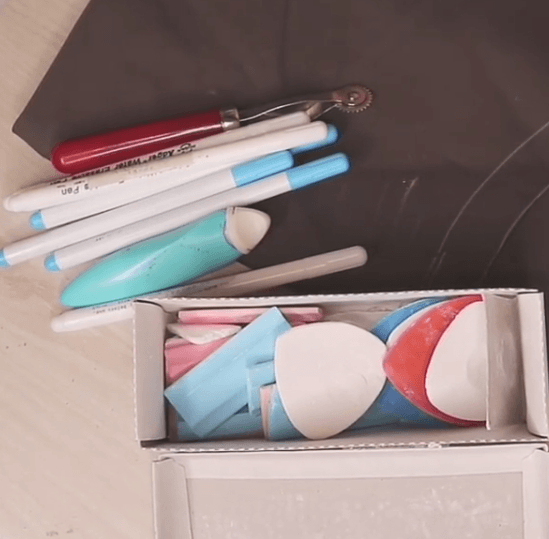
Ordinary tailor's chalk (mineral)
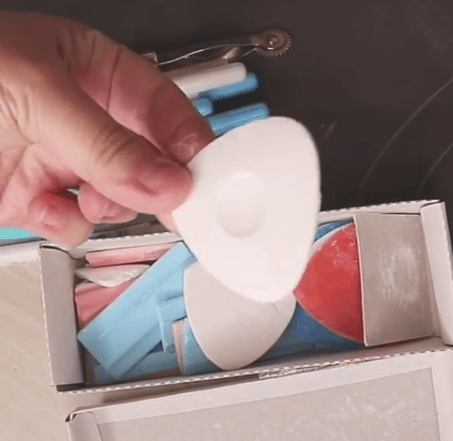
This tool, if you can call it that, has many advantages:
- suitable for any fabric and any color (it even draws well on white);
- not difficult to remove from fabric;
- budget-friendly.
But there are also disadvantages:
- Leaves marks on your hands (though they wash off easily with water). If you aren't careful, you'll smudge the fabric.
- Needs sharpening, otherwise the lines will be too thick.
- It is actually quite difficult to buy real tailor's chalk; there are many low-quality imitations.
## Colored wax crayons
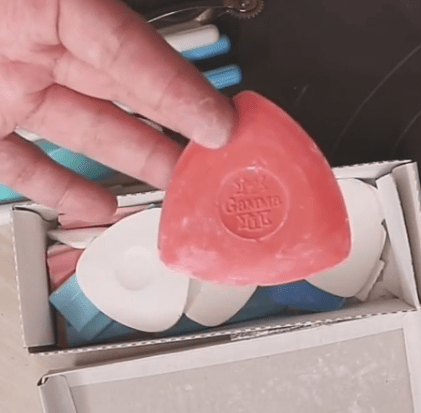
Advantages:
- low price;
- large selection of colors;
- can be bought in any store;
- perfect for working with heavy fabrics;
Disadvantages:
- faint lines;
- the colored mark shows through to the other side if the fabric is thin;
- difficult to remove the mark even after washing, especially if you are working with light-colored fabrics.
## Water- or steam-soluble markers
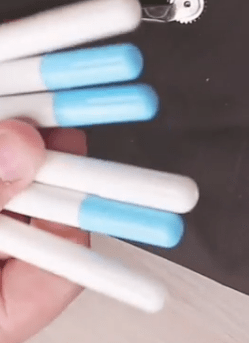
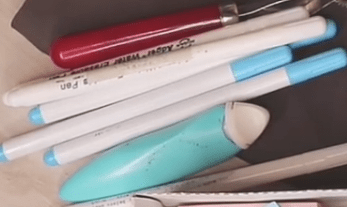
Advantages:
- Do not stain hands or fabric during work.
- Can draw both thick and thin lines.
- High-quality markers are easily washed off with water (or steam, depending on the type).
Disadvantages:
- Low-quality markers do not wash off and leave stains. Always test on a small scrap of fabric before using.
- Not suitable for long-term projects; they dry out (or bleed) after 3-5 weeks. Therefore, they are only suitable for those who sew a lot and often.
- There is a huge variety, and you often have to choose based on the fabric type.
- Relatively high price (not a million, but significantly more expensive than chalk).
> Self-erasing markers have the same advantages and disadvantages as water-soluble ones, but work on a slightly different principle.
## Chalk pencils and wheels
Among the pros, it is worth noting:
- draw thin lines;
- do not stain hands.
Among the cons:
- Requires periodic cartridge replacement;
- Not all marks wash off with water.
- Can crumble.
- A clear mark is not always visible.
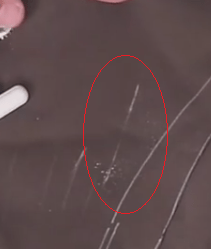
Soap slivers – the "old-school method"
- Pros: accessibility. I think everyone has a few pieces at home.
- Cons: faint marks and potential stains (though not always).
## Stationery pencils and felt-tip pens
Suitable for working with mock-up fabric, but should never be used on fabric for the final garment.
## Summary
I cannot answer the question "*Which fabric chalk is the best?*" because there is no single answer. Of the ones that write well, choose the one you find most comfortable. For me, it's water- and steam-soluble Chinese markers (I bought them on AliExpress and don't regret it at all).
> Note! High-quality Chinese markers don't show up immediately, but after a few seconds. And if you want a self-erasing one, it's not suitable for long-term sewing projects, as it dries out within a month.
But I can highlight the worst option – the chalk pencil. It crumbles a lot, leaves many unnecessary marks, and doesn't always produce clear lines.
And which ones do you use?


