
How to choose sewing machine thread? Selecting based on fabric properties
The quality of your machine stitching depends on choosing the right thread. It is important that the thread thickness matches the fabric and its fiber properties. If the thread thickness does not match the fabric type or needle size, you may experience uneven stitching or skipped stitches. And don't forget the needle: a thin needle will quickly dull or break when used on heavy denim.
> Note! Silk thread is considered universal. It can be used for almost any type of fabric. For thin materials, use size 120/3, and naturally, the thicker the fabric, the lower the thread number. For cambric and crepe de chine – 100/3; for calico, raincoat fabric, and silk – 60/3; for wool coating, burlap, and canvas – 40/3.
## Matching thread to fabric
The choice of thread size depends directly on the density of the fabric:
- For sewing knitwear or cotton fabrics, standard cotton threads of size 40-50 are perfect.
- If you decide to sew chiffon (or other airy fabrics), you can use nylon (size 80-100), polyester (size 60-80), or cotton (size 80-100) threads.
- Clothing made from dense suit fabric? Use thread sizes 50-70. Nylon, polyester, or cotton are also suitable.
- For thin wool and synthetic fabrics, you can use threads with a thickness of 40 to 70. If using nylon, choose 50 to 80.
- For heavy fabrics, genuine and artificial leather, use dense threads from 30 to 60. If using polyester, choose 40-50.
I am also including a fabric and needle compatibility chart that I use.
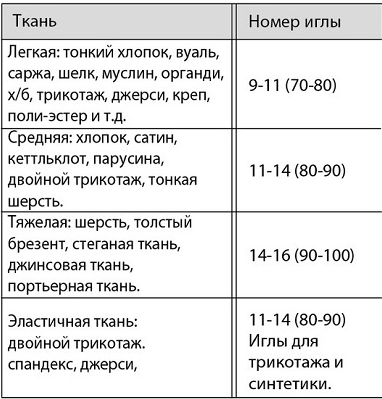


Yes, you were answered correctly. I have already replaced all my old needles and they have the new numbering, but my mom's still have the old one. And the tables always list both so you can understand how the old numbering corresponds to the new one.