Thread breaking while sewing: causes and solutions
There are many reasons why thread breaks. As a rule, most of them can be fixed on your own, even if you have only recently started sewing. Below, I will try to explain how to handle this problem.
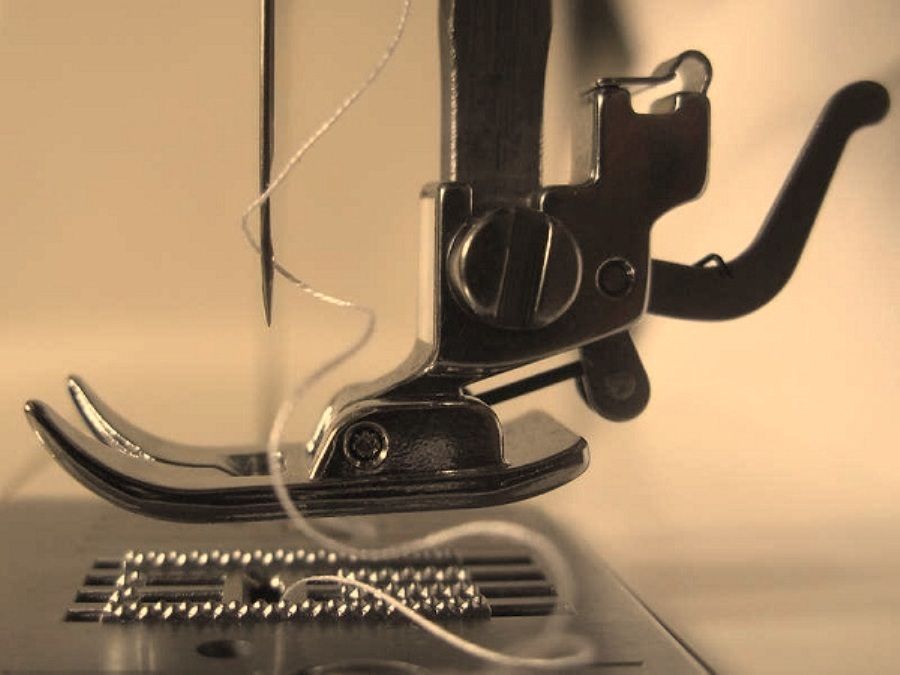
## Tension
In about 80% of cases, incorrect upper thread tension leads to breakage. Although modern electronic machines control tension automatically, inexpensive household machines only provide manual adjustment.
I recommend double-checking and adjusting the upper thread tension when changing fabric thickness, installing a new needle, or switching to thicker or thinner threads.
If the upper thread is tensioned correctly, the stitch will be neat on both the right and wrong sides, and the point where the upper and lower threads interlock will be invisible.
Another sign of correct tension adjustment is that the thread should not be too tight when pulled slightly with your fingers from under the presser foot while it is in the lowered position.
By the way, a little life hack: use a contrasting thread color for the bobbin when adjusting your stitch. 😉
Less frequently, thread breakage occurs due to tension that is too loose. During sewing, loops that are too large form in the bobbin case, causing the thread to tangle and break. It is best to adjust the bobbin case tension only as a last resort (when working with very thin or very thick fabrics/threads). Turn the adjustment screw by a maximum of half a turn; do not turn it more, as there is a risk it could unscrew completely due to vibration during operation.
Another life hack: the bobbin thread should pull out of the case by 3-5 cm if you give it a sharp tug while holding the case in the air. If it continues to unspool, the tension is too loose; if the thread does not come out at all, it is too tight.
## Needle
Incorrect needle movement or misalignment can cause breakage. As a result, the needle hits the needle plate and interferes with the presser foot or internal machine parts. Try replacing the needle if the shaft is bent. If that does not help, you will need professional assistance.
Just in case, check that the needle size matches the fabric being used.
## Thread
Very often, the cause can be quite simple: poor-quality thread. That is why I advise purchasing thread only from specialized stores and carefully ensuring that the needle size and thread thickness are appropriate for the specific type of fabric.
I do not recommend using old thread from the Soviet era. While it may have been high quality 30-40 years ago, it has likely dried out or degraded over the years, so its strength is questionable.
I think I've covered everything... At least, I haven't encountered other types of problems. How about you?


The reason might not just be nicks. There was a case where the thread on the adjustment screw was simply stripped. As a result, you think you are loosening the tension, or conversely, tightening it, but the screw is just holding the plate in one position. In the end, a lot of time was wasted and we took the machine for repair, where the technician, right in front of us, took out (literally took out) the screw without unscrewing it, using a regular magnet.