
Types of Sewing Threads: A Brief Overview of Properties and Applications
Choosing the right sewing thread is a crucial factor that affects the quality of your sewing machine's performance.
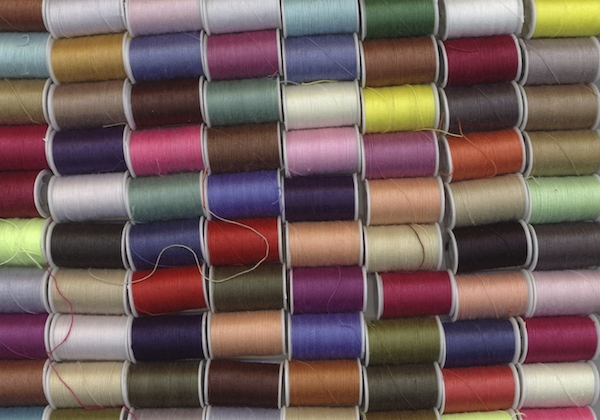
You need to select the correct thread thickness for each specific fabric and match it with the right needle. The thread must pass freely through the needle eye without creating excessive friction with the shuttle mechanism components.
For experienced sewists, this information is basic knowledge, but it is essential for beginners, as sewing and tailoring courses often pay little attention to thread selection.
Let's briefly list the different types of threads for machine sewing.
## Reinforced Threads
These threads have a polyester (lavsan) core wrapped in fibers of various materials.
They are marked as follows:
- LH – indicates the thread is made of polyester and cotton;
- LL – made of linen and polyester;
- LSh – made of polyester and wool.
The numbers on the spools indicate thread thickness. For example, 35 or 45 (45 is thicker).
Reinforced threads are durable, strong, and elastic.
Synthetic Threads (100% Polyester)
These threads are labeled as 100% polyester.
They are tightly twisted, so they rarely fray. Furthermore, they have a consistent thickness throughout the length of the thread. This quality significantly impacts the smoothness of the stitch, especially when overlocking.
## Nylon Threads
These threads are moisture-resistant, which is why they are frequently used for footwear.
Nylon threads can be twisted from multiple strands or consist of a single monofilament.
Monofilament is an ideal choice for blind hems and hemming garment edges. However, keep in mind that monofilament is quite stiff, prone to tangling, and somewhat resembles fishing line.
## Threads for Decorative Stitches
These threads have a specific purpose: decorative stitching. They are thicker, which requires switching to a larger needle size.
In addition to the machine sewing threads mentioned, there are many threads for hand sewing, including embroidery threads, beading threads, and even macramé cords.
I would like to address the question: should you use old cotton threads?
It is clear that professional dressmakers are unlikely to use such threads, but hobbyists might be tempted to use old supplies.
You definitely shouldn't! Not only are old threads weak and prone to breaking, but they also increase wear and tear on modern sewing machines. The issue is that vintage threads have low elasticity, causing them to "cut" into the surface of plastic horizontal shuttles.
Therefore, it is better to buy high-quality modern threads, especially since there are no issues with finding the right color or thickness.
What threads do you use? Let's share our experiences!


A tricky question. I came across information that for modern sewing machines, it is better to use threads with a right-hand twist (it was a discovery for me that they could be different; I always thought all threads were twisted the same way in one direction). They claim that such a thread breaks less and the stitch lays better. Does anyone know or has anyone encountered such a dilemma? Please tell me, is it true or not? And is there really a difference in thread quality depending on the twist method?Show full quoteCollapse