
Double needle for sewing machines: types and usage
A double needle can be installed on almost any modern sewing machine. As the name suggests, this sewing tool allows you to create two neat parallel stitches simultaneously, which can be used both for decoration (a clear example is the topstitching on jeans inseams) and for securing seams.
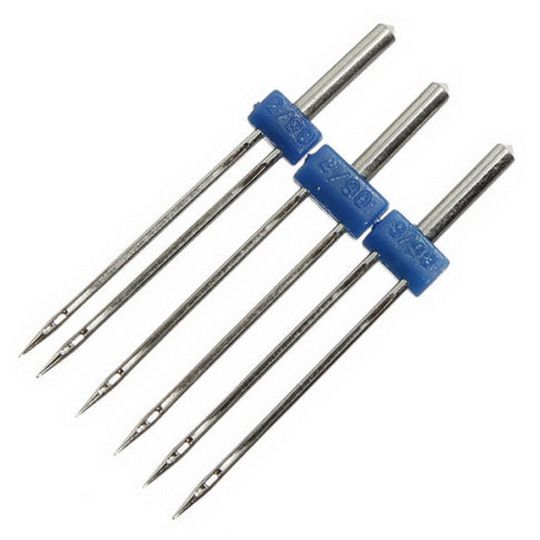
First, let's look at the types of double needles.
All double needles look roughly the same: two shafts connected by a crossbar. In addition to the manufacturer, double needles can vary by:
Shaft thickness – just like with regular needles (e.g., 70/10 or 80/12);
Distance between the needle points = stitch width (the interval varies from 1.6 to 8 mm);
Purpose (universal, for denim, knitwear, metallic thread, hemstitch, embroidery, etc.).
A double stitch can be used for:
Decorative topstitching (simultaneous with attaching, for example, patch pockets);
Creating double straight stitches (e.g., hems and sleeves on T-shirts);
Securing seam allowances;
Attaching ribbons;
Quilting;
Creating elastic knit stitches (when used with a special presser foot).
The stitch is formed by the top threads. It is very important that they have the same thickness and texture, otherwise they may break. For the bobbin, it is recommended to use a thread one size thinner than the top threads.
Does anyone have this tool? Share your experience working with a double needle!


I have a universal needle. In my experience, it's suitable for finishing jeans, even the hem, but you need to work very carefully, slowly, and g-e-n-t-l-y. 🙂
I want to add a little bit because I think it's important for a potential buyer to know.
First, a twin needle should not be bought blindly! Its width must be LESS than the maximum zigzag stitch width provided by your machine.
Second, don't skimp on needles! I recommend looking for what you need in the Schmetz and Organ brand ranges. Prices for them vary from 60 to 80 UAH (for the most common ones).
Third, choose the right distance between the needles. To do this, you need to find out the maximum stitch width (usually it is between 4 and 9 mm). Subtract the distance between the needles from this value, and you will find the maximum stitch width when working with a twin needle. I probably didn't explain that clearly... let me clarify now)))
Example: the machine's stitch width is 7 mm, and the distance between the needles is 2 mm. We calculate: 7 minus 2 equals 5 mm, i.e., you can perform decorative stitches or zigzag with a stitch width of no more than 5 mm.
Before you start sewing, double-check anyway. To do this, manually turn the handwheel to sew a short test stitch and make sure the needle does not hit the presser foot.
Oh, and I forgot one more thing. Such a needle can indeed be put on ALL modern sewing machines. It is only incompatible with old ones – like the "Podolsk". This is all because such machines only have a narrow needle hole and do not have a zigzag function. The twin needle will simply break.