
What fabric should you use for pockets?
A strange question? If we are talking about a simple patch pocket on a summer dress, it's clear – we sew it from the same fabric as the main pieces. Although, there can be nuances here too – pockets can be a contrasting color. I want to talk about more complex pockets where choosing the fabric is not so straightforward.
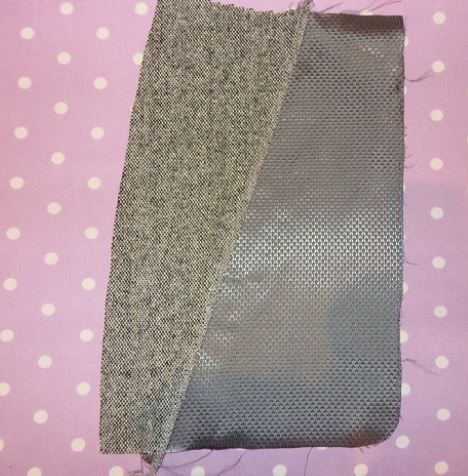
First, to avoid confusion, let's list the basic set of parts for such pockets:
- finishing elements – these are what are visible on the right side: flaps, welts, frames;
- pocket bag – the inner part of the pocket; usually made of two pieces, but can also be one-piece;
- facing – covers the pocket bag at the pocket opening, hides the bag when we put our hand in or put something inside; another purpose of this part is to protect the pocket bag from abrasion; the facing can be attached or one-piece.
Now for the main thing – what should you sew them from?
Finishing details, the facing, and the pocket itself (if it is a patch pocket) are always made from the main fabric or a companion material (matching in color, structure, etc.).
But for the pocket bag, there can be different options: it can be sewn from the main fabric, lining fabric, or a special pocketing fabric.
Both pieces of the pocket bag are made from the main fabric if it is thin, durable, pleasant to the touch, and you have enough of it.
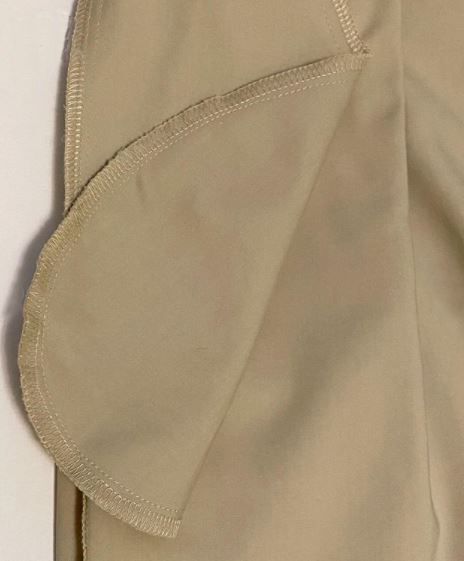
If your main fabric is of medium thickness or you have little of it, then one piece of the pocket bag is cut from the main fabric, and the second from the lining fabric. This option is used, for example, for pockets with a cut-on side piece on skirts, trousers, dresses, and in welt pockets on jackets.
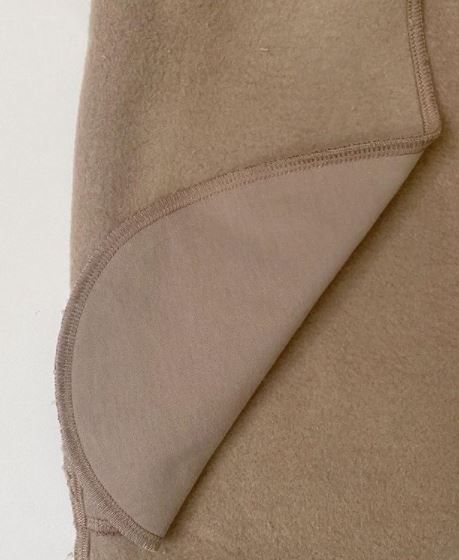
If the main fabric is thick or bulky, the pocket bag is made entirely of lining fabric or pocketing. In such cases, the pocket opening is finished with a facing.
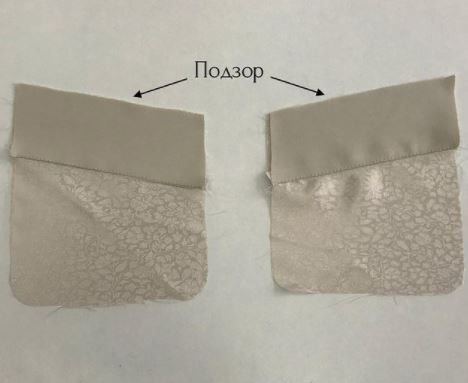
The most common example is pockets in outerwear.
How to choose the right lining fabric or pocketing?
Pay attention to the following points:
- the fabric should not create extra bulk;
- it should match the stretch properties of the main material and be comfortable to use;
- the fabric should be dense and tear-resistant;
- pleasant to the touch.
Natural fabrics (cotton, viscose, silk), blends, or synthetics meet these requirements.
Sometimes, materials that contrast with the main fabric are used to make the pocket bag. Or ones close in color but with a print. And I've seen this not only on children's clothes. How do you feel about such bold decisions?
For this post, I used materials from (https://www.instagram.com/vikisews.patterns/). Thanks to the author!
If the pocketing fabric can shrink, pre-wash it before cutting so the pockets do not distort after laundering.


Oh, I know that feeling. Do I understand correctly that you're talking about the corners at the opening? The general recommendation is to make a reinforced stitch in those areas, like a triangle or a rectangle. But, as my experience has shown, that doesn't help. The corners of the pockets get ripped out "with the meat," i.e., with the fabric of the main piece. I found only one solution. I sew a patch onto the inside of that area. The color of the patch can be anything, the main thing is durability and a small thickShow full quoteCollapse