
Features of Drafting Detached Visors
In headwear, the visor is perhaps the most noticeable detail. That is why it must be executed perfectly. They are divided into two large groups: detached (i.e., directed forward) and turn-down (i.e., resting on the crown).
Let's focus on the specifics of drafting patterns for detached visors.
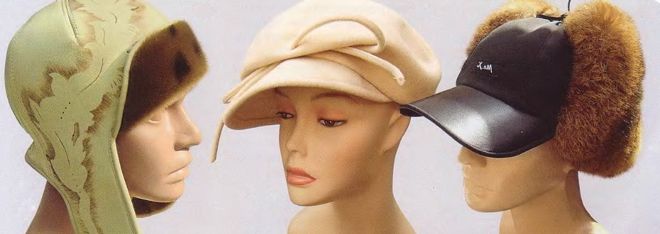
Their design features depend on the configuration of the outer edge, while the fit is determined by the inner edge line.
Detached visors can be positioned perpendicular to the forehead, at an angle to it, or lie flush against it.

.
The angle at which the visor sits is influenced by the properties of the material and the radius of curvature of the inner edge. The larger this radius, the lower the visor will sit, and the smoother the transition to the crown will be. Such visors look perfect on traditional women's headwear.

For visors that lie flush against the forehead, the inner edge line is straight. This style is usually used on headwear with a high attachment line, such as naval-style caps or small, dapper peaked caps.

The majority of visors are made with a moderate curvature of the inner edge line.
On modern sports headwear and classic men's caps, the curvature of the inner edge line is kept to a minimum. With a very small radius at the center of the visor, a fold is created that lifts the visor above the attachment line. This quality is sought after for jockey caps and fantasy headwear. Sometimes a variable radius of curvature is used, gradually decreasing from the center to the sides.
The length of visors on sports models is moderate. On classic women's headwear, the inner edge line is made longer. Often, such visors approach the size of a half-brim. By the way, if the length of the inner edge of the visor is less than or equal to 1/2 the length of the cap's attachment line, it is considered a visor; for longer versions, it is already a half-brim. To prevent flaring at the sides on such visors, the radius of curvature of the inner edge is smoothly reduced from the center to the sides, possibly even down to a straight line.

Let's look at different visor shapes.
The shape and width of the visor are determined by the outer contour of the piece. Usually, the width is 3-4 cm (on women's fur hats) or 8-12 cm (on leather sports caps and jockey caps).
All shape variations can be conditionally divided into two groups:
- those that fit roughly into a quadrilateral (trapezoid or rectangle);
- those that fit roughly into a triangle.

In different years, one or the other shape variant has been preferred. For example, in the 70s, visors of the first group were popular, while in the 60s and 80s, ladies preferred the more modest second type. Modern fashion is tolerant of any shape variant, from triangular to asymmetrical.


A detachable visor can help correct certain, so to speak, facial features. And standard patterns don't always work here. Not to mention special hats. I remember how much I struggled when I was sewing a beret for a child's New Year's costume. I drafted the pattern myself based on a sample, and then adjusted it as I went.