
What to consider when sewing with linen
Linen is considered the most eco-friendly material. In the summer heat, linen garments are simply indispensable. However, this material has its own characteristics that must be taken into account to ensure the finished garment turns out perfect.
Let's recall the positive properties of linen fabric, which are precisely why it enjoys such great and well-deserved popularity.
This material is highly hygroscopic, meaning it absorbs moisture well. Linen dries quickly. In hot weather, linen clothing lowers body temperature by several degrees.
Linen does not build up static electricity, it is not easily soiled, and it possesses antiseptic properties.
Over time, linen fabric does not yellow, but rather becomes lighter and softer.
And now, let's recall the problematic properties.
Linen fabric shrinks significantly (up to 10%) when washed.
The cut edges of the material are quite "fray-prone," so when buying fabric, you need to increase the required length by 10–15%.
Before cutting linen fabric, pre-shrinking is mandatory. Soak light-colored solid fabric in hot water; for dark fabrics and fabrics with prints, the water temperature should not exceed 40 degrees. If you plan to machine wash the finished garment later, it is advisable to wash the fabric as well. However, do not use a high-speed spin cycle, as this will cause creases.
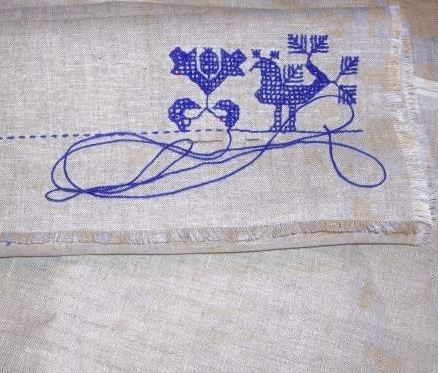
To avoid distortion, it is best to baste or even stitch the fabric edges together before washing, folding it in half with the wrong side out. The fabric should be dried in a fully spread-out state.
Linen fabrics should be ironed while slightly damp using a hot iron with a steamer.
Considering the "fray-prone" nature of linen, when cutting, it is better to make the seam allowances generous and finish them with an overlock immediately.
Often, the weave of linen fabric has a loose structure. In this case, the seam areas should be reinforced with a narrow strip of fusible interfacing. This is especially important for areas where zippers are inserted. The stitching in this case should run almost along the interfacing, 1–2 mm from the edge.
Linen fabric can stretch significantly. Therefore, if you want to sew a fitted dress, be sure to use a lining.
And what secrets of working with this fabric do you know?
Pre-wash and press linen before cutting: linen can shrink noticeably, and this is easier to handle before sewing.
For more fabric-selection context, see the guide to two-thread and three-thread knit fabrics.


You took the words right out of my mouth ))) I had "maternity" linen trousers that I loved very much for their comfort and lightness. But their appearance after sitting in them was just a disaster. Every time, I wanted to throw them away. But after washing and ironing, they were beauties again )) Now I have other linen trousers, "banana" style, and I can't get enough of them: they simply saved me in the heat. By the way, they didn't wrinkle much. Unlike the first pair, this linen has a tighter weave and is noticeably heavier in weight.