
How to Choose a Sewing Machine Needle: Reading the Markings
To simplify working with materials that differ in composition, density, and tendency to fray, it's important to choose the correct needle for a home sewing machine. Most needles have the same construction: shank, shaft, eye, point, but they differ in point style, eye and groove shape, shaft thickness, etc. These differences are not noticeable to the untrained eye, so it's worth learning to read the markings on needles.
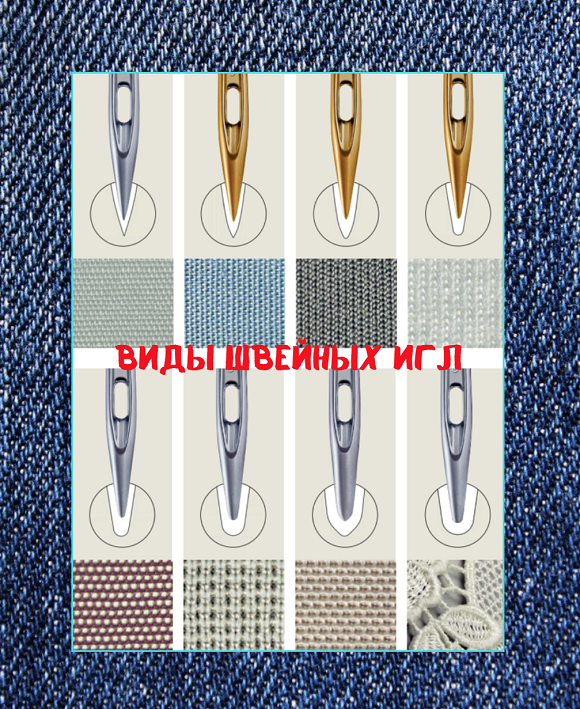
1. Universal needle - H. Has a slightly rounded tip, suitable for "non-fussy" fabrics. Ideal for cotton, calico, and linen.
2. Microtex - H-M. Has a very sharp needle point and a thinner shaft. Used for stitching raincoat/coated fabrics, fabrics with finishes, dense silk, and taffeta.
3. Jeans needle - H-J. Has standard thickness but a sharp point. Suitable for materials like denim, twill, and heavy-duty cover fabrics (canvas).
4. Stretch needle - H-S. Made with a special edge that prevents skipped stitches and a rounded tip that pushes aside rather than pierces the fabric threads. Used for natural and synthetic stretchy fabrics and knits.
5. Embroidery needles (H-E). Also have a rounded point, a small eye for the thread, and a special groove in the construction.
6. Embroidery needles for metallic thread - H-EM. A polished eye construction not only helps embroider without damaging the fabric but also prevents the metallic thread from fraying.
7. Quilting needle - H-Q. Used for decorative stitching. Has a special bevel, a reduced eye, and a rounded tip.
8. Jersey needle - H-SUK. Also has a rounded tip that doesn't damage the fabric. Suitable for dense and heavy knits, jersey.
9. Decorative stitch needle - H- LR, H-LL. Pierces the fabric at a 45-degree angle, creating stitches with a slight slant.
10. Twin needle H-ZW I. Used for hemming knit garments. On the right side this needle makes 2 straight rows of stitches; on the wrong side it forms a zigzag.
A few words about manufacturers. The best needles today are considered to be from Altek Beissel (Austria), "Igly Arti" — Russia, Organ Needle — Japan, and Schmetz — Germany.


I think this needle size selection chart will still be useful to many. I hardly sew clothes, but I love patchwork and often work with fabrics from old clothes. Choosing the right needle helps avoid the 'agony' of skipped stitches and various puckering that you then have to fix. Sharing 🙂