
Top 10 Unusual Knitting Techniques for Those Who Have Tried Almost Everything
Every knitter probably has those moments when you don't know what unusual thing to knit next. It's not about alternating stitches; you want something truly interesting and original. 🙂 Today, I'll share ten super ideas for creating beautiful projects. You might need additional tools for these, but they are inexpensive and available in any decent craft store.
So, shall we begin? 😉
Brioche Technique

Two-color knitting with needles. Used to create patterns on sweaters, cardigans, hats, and scarves. We have a tutorial on our forum for knitting a scarf; I suggest taking a look: Knitting a two-color pattern in the brioche technique
Short Row Knitting

Another interesting and versatile knitting technique. It's great for scarves and sweaters, and an excellent option for those who want to use up yarn scraps! The KomoK forum has a thread dedicated to short rows: How to knit a men's scarf using short rows
Hairpin Lace

To work, you will need a crochet hook and a hairpin lace loom—a U-shaped wire frame. Lacy strips crocheted on it are removed and joined together. This technique is used for shawls, scarves, and lacy tops. This beauty, available for sale at our Fair, was made using this technique: Stole "Winter Lace"
Irish Crochet

Individual motifs are crocheted and then assembled into a single piece, joined by a hook or needle. I will talk about knitting such lace a little later. 😉
Freeform

The founder of this technique was Prudence Mapstone. Freeform is an incredibly beautiful, irregular knitting style without rules or patterns. It vaguely resembles Irish crochet—individual motifs are created and then assembled into a single piece. It uses several styles at once, different yarn thicknesses, and additional elements like beads, rhinestones, ribbons, etc. This technique is used not only for clothing, scarves, and blankets but also for pictures, bags, and various decorative ornaments.
Knooking

To work, you will need a special tool that combines a needle, a Tunisian hook, and a regular crochet hook. The result is a dense, stretchy fabric that looks identical to needle-knitted fabric.
Knooking is convenient for knitting socks, mittens, children's toys, and small items in general. We have a thread on our forum for discussing this technique: Knooking (3-in-1 technique). Who has tried it?
Tunisian Crochet

Another method using a long crochet hook (from 30 cm) with a stopper on the end opposite the hook. The fabric is worked in straight rows without turning. Knitting is done first from right to left, then back again. Such items hold their shape perfectly, so it is recommended to use this technique for slippers, bags, coats, and cozy sofa blankets.
Tunisian Crochet with Double-Ended Hooks
Something between knitting and crochet. You will need two double-ended hooks! Each row is worked with its own hook and, often, its own color. Tunisian crochet (both methods) is currently at the peak of fashion. It is used both independently and in combination with other techniques.
Pooling
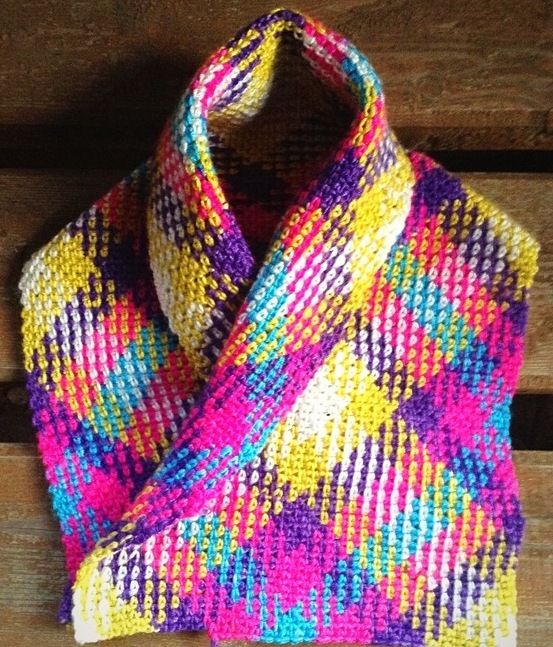
Knitting is done with needles and variegated yarn. It doesn't look like the usual spots, but rather like vertical stripes or other geometric patterns.
Ancient Needle Binding (Nalbinding)

Knitting with a special thick needle made of wood or bone. It was widespread and is still used in northern Russia and Western Europe.
Of course, these are far from all the options. I hope experienced crafters will share their own versions of unusual knitting in this thread. 😉
Because unusual knitting techniques can change yarn consumption, the guide on calculating yarn for a scarf is useful before starting a larger project.


It's great to share unusual things, the idea is super!
I'll drop a masterclass on working in the entrelac technique into this thread: CLICK HERE
It's something between knitting and weaving. I used to think that you could only knit blankets, bedspreads, and pillows this way, but it turns out you can also make scarves, snoods, mittens, and even hats!