
The Softest Chair Pad: Zero Waste
To create cozy furniture for your summer house, hallway, or kitchen, it's worth spending a little time sewing soft chair pads. There's no need to buy fabric for such projects, and you don't have to! Let's try sewing with what we have at home. I suggest using my favorite "pizza" technique, but with some improvements that will be especially useful for beginners. A couple of tips will help you avoid mistakes and difficulties. In just an hour or a little more, you will get the softest chair pad, which can also be safely washed without losing its quality.

What you need for the project:
- A piece of sturdy fabric of the appropriate size for the base. You can cut it from old clothes.
- Padding. Polyester batting or even an old wool sweater that is no longer worn will work.
- Scraps of fusible interfacing. In principle, you can do without it, but this material makes the work much easier.
- The smallest fabric scraps and even threads from unraveled knitted items.
- Mesh, tulle, organza, or a thin translucent scarf.
- A regular household sewing machine. A free-motion quilting foot is not needed.
How to sew a chair pad using the "pizza" technique
Step 1
Cut out the materials and assemble a "sandwich": the base, batting or other insulation, and rows of interfacing scraps to fill the surface. Cut the pad with a 2-3 cm margin; excess can be trimmed later.

Step 2
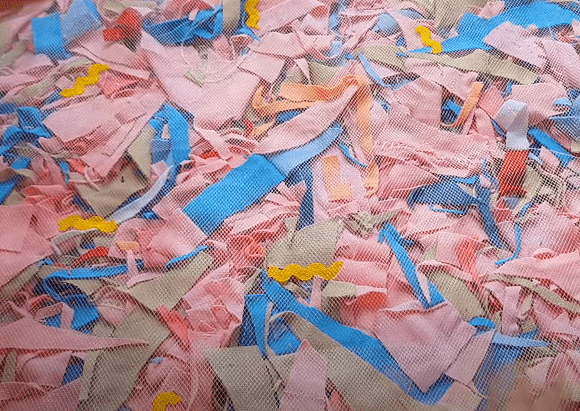
Scatter the scraps in a fairly dense layer. In my case, these are knit fabric scraps, which are softer and create the necessary volume.

Step 3
Place the mesh over the layer of scraps, then cover the pad with cheesecloth or cotton fabric and press (do not iron!) with a hot iron. This will help all the layers "bond." This method helps avoid a problem familiar to all beginners: when sewing a "pizza" quilt, the scraps tend to "run away," making it quite problematic to sew even a small piece. If you use a large number of pins, there is a real chance of pricking your hands while sewing.
Step 4
For safety, pin the fabric in various places and begin quilting.
Perform a straight stitch back and forth approximately every 2 cm. We won't make "squares"; the fabric holds together well enough on its own while maintaining volume and softness.

Trim the finished chair pad, removing any excess, clean up the threads on the back, and finish the edges.

To attach it to a stool or chair, simply sew 4 ties to the corners.


I think I can handle this project too :). I've been wanting to sew a bathroom rug like this for a long time, with those 3D "ribs". And I definitely have enough jersey scraps from old t-shirts!