Sewing Machine Presser Feet: Types and Applications
The presser foot is an essential part of a sewing machine. Modern machines come with a wide range of feet, each with its own specific application and features. Today, I will briefly tell you about the feet used for basic sewing operations. 😉
Universal Zig-Zag Foot

As a rule, it is included with the sewing machine. It is capable of performing both straight stitches and zig-zag stitches with adjustable width. I recommend looking for a foot with a horizontal locking button on the sole (it makes it easier to cross seams and sharp changes in fabric thickness).
Straight Stitch Foot

Used for even stitches. It ensures excellent seam quality on materials such as silk and satin.
Zipper Foot

It can be:
- universal (can be adjusted to the left/right – you don't have to turn the garment while attaching the zipper tape);
- narrow and one-sided;
- for invisible zippers (places stitches close to the zipper teeth).
Such feet are also used for attaching piping and for sewing in hard-to-reach places.
Blind Hem Foot

Works with dense fabrics, creating invisible stitches – usually for hemming skirts, trousers, etc.
Before you start sewing on your garment, be sure to test the stitch on a scrap of fabric and adjust the necessary settings!
Overlock Foot
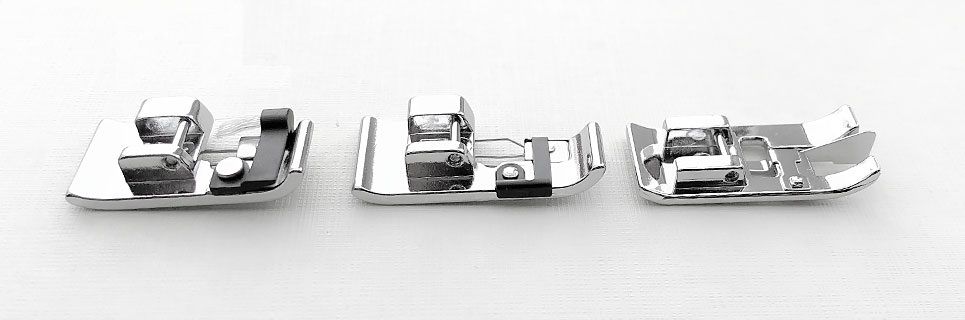
Its feature is the presence of a pressure and guide plate. This is why the finished edge does not pucker after the stitch is made. In addition to standard overlock feet, there are models with a side cutter available – they not only finish the seam allowance but also trim it.
Button Sewing Foot

The main requirement for this foot is that the width between the button holes must not exceed the maximum zig-zag width. The foot has rubberized pads that help to securely hold the button in place. Buttons are sewn with a zig-zag stitch with the feed dogs disengaged!
Buttonhole Foot

Processing a buttonhole, depending on the machine model (semi-automatic or automatic), is performed in one or four steps. Different types of machines require different feet!
For automatic buttonholes, there are feet with a plastic frame. With its help, you can adjust the length of the buttonhole for any button (you will need to insert it into the back of the frame and lock it).
For semi-automatic buttonholes, additional markings are applied to the sides of the frames. Modern sewing machine models may include a sensor buttonhole function, which requires a special foot.
Bias Binder and Hemming Foot

Feet for binding and hemming are often called "scroll" feet. And for good reason – these models have specially curved soles that allow you to quickly fold and stitch the binding or edge. They come in different widths!


And why is no one talking about a foot for knit fabrics?
It sometimes even comes included with the sewing machine. I use it quite often – I sew clothes for the kids for playing outside.
On a sewing machine (at least on mine), it's hard to sew elastic fabrics. The knit fabric simply gets stuck in the feed dog teeth. And it's also difficult to choose a stitch for knitwear from the available ones... I.e., either the zigzag, or the seams will burst sooner or later. A knit foot helps to work with such fabric if you choose the right needle and type of stitch.
The design has a special stopper, with the help of which the fabric under the needle is tensioned and does not get into the feed dog. Some models of feet can have rubberized or silicone pads for a more secure fixation of the fabric.
When purchasing the foot, be sure to study the manual for your machine, as the choice depends not only on the manufacturer's brand but also on the maximum zigzag width for which the sewing machine is designed (5, 7, or 9 mm).
For a high-quality stitch on knitwear on a home sewing machine, you need to:
Install a special needle with a rounded tip (it doesn't tear the fibers, this is important for knitwear!). Sold in any sewing store under the label Stretch or Jersey.
Use knit stitches and thin threads (preferably with the addition of synthetics) in your work.
Despite the presence of a stopper for tensioning the fabric, I still recommend slightly tensioning the material during straight stitches – such a seam will be stronger.
You can also join knitwear with a zigzag, setting the shortest length and width for the stitches.
Perform hemming using a twin needle. To do this, place the edge on the wrong side between the two stitches, and it will be securely fixed.