
Hand Sewing Needles – A Complete Overview!
The history of hand sewing currently includes 15 (!) types of needles. However, some categories can safely be combined, as the same needle can often be used for two or three different tasks.

In this section, I will highlight the most prominent representatives of the sewing front 😉
1. Basting and Darning Needle: The most standard needle of all; it has a sharp tip and a small eye. I should clarify right away that this shape is only suitable for dense natural and blended fabrics like linen, cotton, etc.

2. Knit and Wool Needle: Must have a rounded tip, which allows it to push fibers apart rather than tearing them. This category also includes embroidery needles (e.g., tapestry needles) – in this case, the eye of the needle should be slightly widened to accommodate a full strand of embroidery floss (or thick wool yarn).

3. Chenille Needle: Intended for ribbon embroidery. Accordingly, it has a wide eye and a sharp tip. The size is chosen based on the width of the ribbon. A chenille needle is also suitable for satin stitch embroidery.

4. Leather Needle: Its tip has a special shape with a triangular grind, which allows it to cut through dense material without much effort.
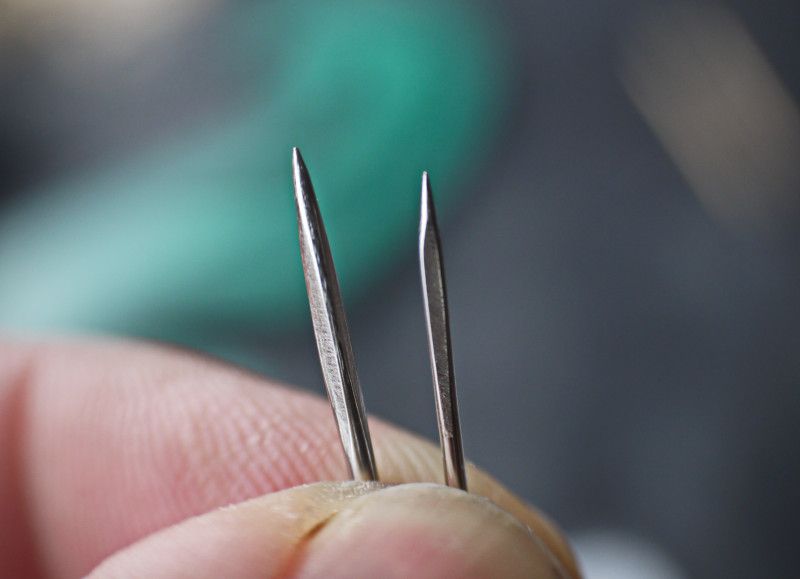
5. Beading Needle: The most fragile and thinnest of all possible needles, sometimes featuring a flexible "collapsible" eye. Beading needles must be of uniform thickness along their entire length so they can easily pass through even tiny beads.

6. Sailmaker's Needle: The complete opposite of a beading needle – powerful, long, and thick. Needed for sewing large-scale canvases like sailcloth, tarpaulin, or coarse burlap.

7. Appliqué Needle: Has increased resistance to bending, must be very sharp, and also have a special coating (or polish) for maximum smooth gliding.

8. Quilting Needle: A real "shorty" among other needles. However, it is convenient for making small, neat stitches.

9. Needle for the Visually Impaired: Distinguished by an angular, wedge-shaped sliding eye that allows the thread to "feel" its way into the right direction and pull into place without any trouble. By the way, it's an excellent needle not only for those with poor eyesight but also for the impatient who don't want to spend a long time threading a needle 😍


I would also classify a double beading needle as a special tool: it is very thin, flexible, and easily splits into two halves, turning into one large eye – it's very easy to thread the thinnest and most transparent beading thread through it. Despite its giant size (10-12 cm), it's comfortable to sew with 👍