
Sharing secrets on how to quickly sharpen scissors at home
Every seamstress, even a beginner, knows that it is difficult to sew good clothes without good tailoring scissors. However, as a result of use, the tool can become unusable, and it often happens that you have to buy new ones.
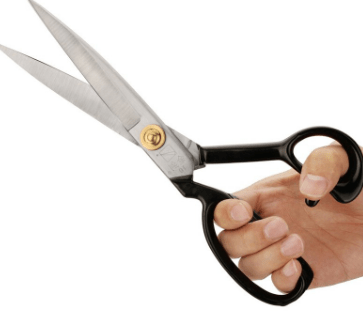
First of all, to prevent damage to your tools, it is necessary to follow simple rules for scissor care that few people remember:
- wipe all parts of the scissors after use;
- store the tool closed;
- periodically lubricate the scissor blades with the oil you use for your sewing machine;
- don't forget to lubricate the pivot point where the two halves meet;
- if there is a screw at the pivot point instead of a pin, don't forget to tighten it so the scissors don't become loose;
- use tailoring scissors only for their intended purpose.
Although these rules are quite simple and straightforward, failing to follow them quickly leads to dull scissors. To sharpen them, you can take them to a professional, or you can sharpen them at home. You can use various improvised methods for this.
Sandpaper. For this method, you will need the finest grit sandpaper available. Cut the paper with the dull scissors until the tool becomes sharp. This is a good and effective method, but you may not always have the right grade of sandpaper on hand.
Metal kitchen sponge. A regular metal kitchen scouring pad can also restore lost sharpness to your scissors. The sharpening principle is similar to using sandpaper. The result of this method will undoubtedly please you. But there is a downside: when cutting the metal sponge, small pieces of metal fiber can break off, and as luck would have it, they might eventually get stuck in your finger or heel.
Aluminum foil. You can use baking foil or treat yourself to a little feast, unwrap a delicious chocolate bar, and use the foil from the packaging. Fold the foil into several layers and (you guessed it!) start cutting the foil with the dull scissors.
The old-school method - a needle. Hold a needle between the scissor blades, as close to the pivot as possible, and perform slow, sliding cutting motions along the needle. Attention: when using this method, you need to be very careful, because without a certain amount of skill, there is a high risk of pricking yourself with the needle!
Regular glass, or rather, not quite regular, but round-shaped (a jar, glass, or bottle). Just don't take heirloom vases, crystal glasses, or other valuable items, because after sharpening the scissors, there may be unsightly scratches left on the glass. Use the scissors as if you are trying to cut the neck of the jar or bottle. Do everything carefully and without excessive force. It might seem like a somewhat extreme and exotic method, but the result is worth it.
It is clear that the methods described above are not a panacea and will only put your tool in order for a while, but still... How do you deal with dull scissors?
Safety note: these home sharpening methods are suitable for quick maintenance only. Expensive tailoring scissors are better serviced professionally.




For quick sharpening of scissors, any glass or ceramic object that the open scissor blades can grip will work. The procedure is quite simple: you just "cut and hack" the bottom or top of a jar, cup, glass, or even a shot glass.
There is another interesting way to sharpen scissors using ceramics. In this case, you can use both Soviet and modern tableware (there will be minimal damage to the ceramics or porcelain from such sharpening). Turn a cup or plate upside down and move each blade individually along the edge of the protruding bottom (in the place where there is no glossy coating and there is roughness) using circular motions. The method is somewhat similar to sharpening on a diamond wheel, only using a cup or plate.