Sewing a Three-Tier Skirt: A Pattern for Every Size
A step-by-step tutorial for drafting a three-tier skirt pattern: take the main measurements — hip circumference and garment length, split into three tiers — plus extra height measurements from the waistline to the floor at the front, side, and back; calculate the first tier's width, adjust it using the reference points, and calculate the second and third tiers' widths using a gathering coefficient.
Beginner40 minFree
Translated
Things you will learn
A tiered elastic-waist skirt in lightweight fabric is a comfortable summer option, but without adjusting the pattern, it often rides up in front while walking or droops below the waist in back, and can look too full or too tight.
Drafting the pattern calls for two main measurements — hip circumference (HC) and garment length (GL), which you split into three sections for the tiers; the tiers' widths can be equal or differ by almost double, as you like.
Take the extra measurements with a helper: measure the height from the waistline (tie a ribbon or tape around it first) down to the floor at three points — front, side, and back; these figures can differ by a few centimeters depending on your body shape.
The first (top) tier's width is calculated as HC÷2 plus 8-12 cm; keep the largest of the three measurements unchanged as your base point, then adjust the other two points based on their difference from it and connect all three with a smooth line.
You get the second tier's width by multiplying the first tier's width by a gathering coefficient (1.5 to 2), and the third tier's width the same way from the second; every measurement on the pattern is half of the eventual full width.
What you'll get
You'll get a custom three-tier elastic-waist skirt pattern, adjusted to your figure so the skirt won't ride up in front or droop below the waist in back.
Materials and tools
Materials
Measuring tape, for taking the main and extra measurements
Tools
Pencil, for drawing the pattern lines on paper
A ribbon or tape, tied around the waistline before taking the extra height measurements
Pattern paper, for drafting and calculating the pattern pieces
Preparation
Take your main measurements
Let's start with the measurements. We'll need 2 main figures: HC (hip circumference) and GL (garment length). We then split the length into 3 sections sized to the tiers. Their width is up to you — they can be equal, or differ by almost double.
Take the extra measurements with a helper
You'll need a helper to take the extra measurements. Measure the height from the waistline (tie a ribbon or tape around it first) down to the floor at 3 points: at the front, along the side seam, and at the back. These figures can differ by a few centimeters depending on your body shape, which calls for adjustments.
Draft the first tier
The calculation starts from a specific set of example measurements, then gets adjusted using three reference points on the figure.
Set your example measurements
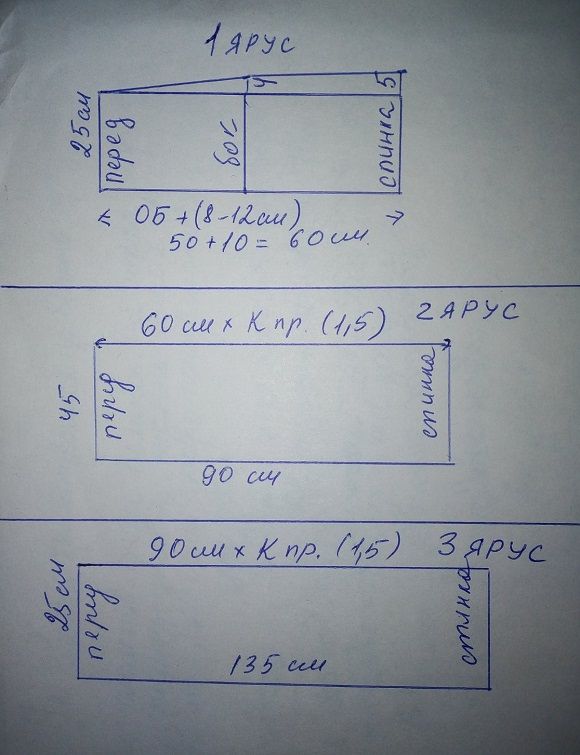
Let's say the measurements for our model are: HC — 100 cm, strip lengths: tier 1 — 25 cm, tier 2 — 45 cm, tier 3 — 25 cm. Now let's do the math.
Calculate the first tier's width
The first (top) tier's width equals HC÷2 plus 8-12 cm. Let's use an average figure. That gives us: 100÷2+10 = 60 cm. The strip's height is 25 cm.
The pattern diagram with measurements
Adjust it to fit your figure
Now we make adjustments based on the three measurements we took earlier. In our case, the largest figure is at the back, so we leave that point unchanged. For the front line, we calculate: 110-105, giving us 5 cm. We raise this point up. The difference between the front and the side line is 109-105, giving us 4 cm. We mark the point, then connect all 3 points with a smooth line.
Draft the second and third tiers
Each next tier's width is calculated using a gathering coefficient applied to the previous tier.
Calculate the width using the gathering coefficient
Now let's move on to drafting tiers 2 and 3. For this, we calculate the strip's width. Our top tier's width is 60 cm, and we need to multiply it by the Gc (gathering coefficient). For skirts like this, it ranges from 1.5 to 2. So the second tier's width is 60×1.5, giving us 90 cm. We calculate the third tier the same way: 90×1.5, giving us 135 cm.
Working out the calculations on paper
Remember the half-width rule
IMPORTANT! Don't forget that every measurement on the pattern is 1/2 of the eventual full width. Once you know these figures, you can calculate your fabric requirements and sew a skirt that will fit any figure well.
Finish and variations
Finish
Calculate your fabric and sew to your figure
Once you know these figures, you can calculate your fabric requirements and sew a skirt that will fit any figure well.
Variations
Make the tiers equal in width
The tiers' widths are up to you — they can be equal, or differ by almost double.
After sewing to just the HC and GL measurements without any adjustments, the elastic-waist skirt rides up in front while walking.
Likely cause
The pattern was drafted using only hip circumference and garment length, without factoring in the three extra height measurements from the waist to the floor at the front, side, and back.
How to fix it
Take the extra height measurements from the waistline to the floor at three points (front, side, back) and adjust the pattern based on the difference between these figures.
The skirt droops below the waistline in back
Problem
After sewing, the elastic-waist skirt droops below the waistline in back, even though it fits fine in front.
Likely cause
The difference between the back, side, and front measurements wasn't factored into the pattern, so the top tier's outline ended up unadjusted for the figure.
How to fix it
Identify the largest of the three height measurements (usually at the back), leave that point unchanged, then adjust the other points based on their difference from it and connect them with a smooth line.
The skirt looks too full or too tight around the hips
Problem
After sewing, the elastic-waist skirt looks either too voluminous or, on the contrary, too tight around the hips.
Likely cause
The wrong value was used for the addition to the hip circumference (8-12 cm) or for the gathering coefficient (1.5-2) on the lower tiers.
How to fix it
Choose the value you add to the hip circumference and the gathering coefficient within the stated ranges, based on how full you want the finished skirt to be.
?FAQ
What measurements do I need to draft a three-tier skirt pattern?
Two main measurements — hip circumference (HC) and garment length (GL) — plus three extra height measurements from the waistline to the floor at the front, side, and back.
How do I calculate the first tier's width?
The first tier's width equals HC÷2 plus 8-12 cm; for example, with an HC of 100 cm and a 10 cm addition, the width comes to 60 cm.
How do I calculate the second and third tiers' widths?
You get each next tier's width by multiplying the previous tier's width by a gathering coefficient of 1.5 to 2.
Why might an elastic-waist skirt ride up in front or droop in back?
Because the pattern was drafted using only hip circumference and length, without adjustments from the three extra height measurements from the waist to the floor.
What's important to remember about the figures on the finished pattern?
Every measurement on the pattern is half of the eventual full width.
Your project
Log in to track your project, attach photos, and publish your result into the shared feed.

 Beginner40 minFree