
How to Make a Chestnut Mat: DIY Assembly Guide
This craft turns gathered horse chestnuts into a flexible grid mat. It is a decorative and recreational project, not a medical device or treatment.
The source's medical claims about children's arches, pressure points, fatigue, and stress are not supported here. If the finished mat will be placed underfoot, set it on a flat, nonslip surface, use stable support, and stop if it feels painful or unstable. Keep it out of walkways where it could become a trip hazard.
The author proposed this as an inexpensive autumn project using fallen chestnuts. Select clean, completely dry, sound chestnuts. Natural material can shrink, split, or develop mold over time, so inspect the mat regularly and replace damaged pieces.
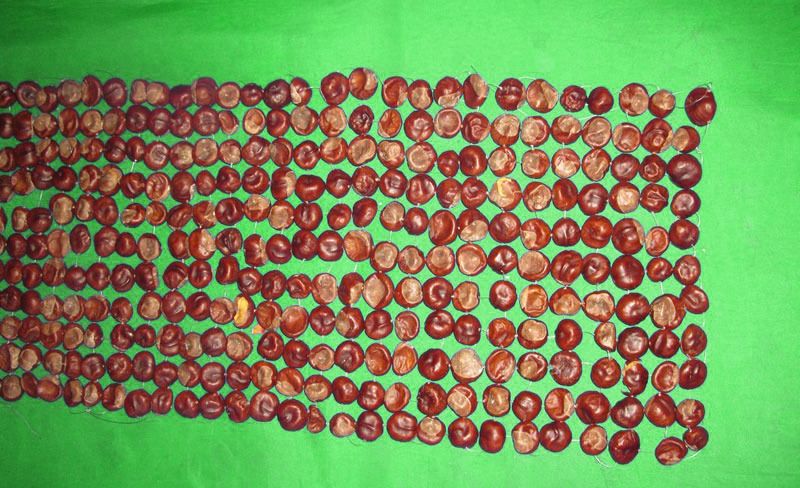
Materials and tools
- many clean, dry horse chestnuts
- thin, strong fishing line
- a drill with a small bit suitable for the material
- a clamp or drill vise and a piece of scrap wood
- safety glasses
- scissors
Drill the chestnuts
Each chestnut needs two through-holes drilled in perpendicular directions so the line can form a grid. Drilling a small, rounded workpiece is an adult operation. Do not hold a chestnut in your hand while drilling. Secure it in a clamp or drill vise over scrap wood, without crushing it; wear eye protection, keep hands clear of the bit, tie back long hair, and remove loose clothing or jewelry. Use a suitable bit and controlled speed, stop the drill before making adjustments, and discard any chestnut that cracks.
Assemble the mat
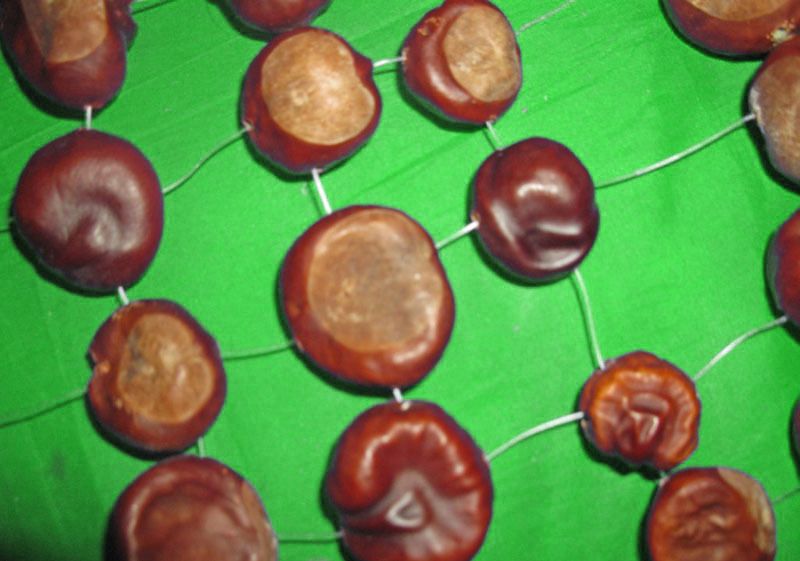
The simplest layout is to string the chestnuts into long horizontal rows, then join those rows with vertical lengths of line. This method leaves many line ends that must be tied securely, trimmed, and tucked away.
For the second layout, string all the chestnuts onto one very long line and arrange it back and forth in serpentine rows. Join the rows across the width with equal lengths of fishing line, tying each connection securely.
The second method takes longer but produces a neater grid. Before using or displaying the mat, check every knot, trim and tuck all sharp line ends, and confirm that no loose loops remain. Keep loose chestnuts and cut pieces of line away from young children and pets.


You could try placing them closer together. The problem is that the chestnuts vary in size, so the fishing-line grid may become uneven and the rows may twist out of alignment. Sorting them to find matching sizes would take a long time, especially because their shapes vary too.