
Mastering a Unique Japanese Patchwork Technique
For many, patchwork is associated with sewing small scraps and strips of fabric. But there is another interesting way to make good use of small textile remnants. By mastering this Japanese patchwork technique, you can create not only cute and charming potholders but also stylish clutches or handbags.

First, cut your fabric scraps into strips (approximately 5-6 cm wide; the length is arbitrary and will depend on the item you plan to sew). Further preparation can be done in several ways:
- Fold each strip in half with right sides together and stitch the edge, then turn it right side out and iron it so the seam is in the center of the strip;
- Fold the edges toward the center, slightly overlapping, and press well. It is also helpful to lightly treat the raw edges with a fabric stiffener.
The rest of the process is simple. The main thing is to follow the steps in order.
Assemble the required fabric base from the prepared strips. Lay out the necessary number of strips on a flat surface and secure the top and bottom edges with binder clips (you can also stitch them or secure them with masking tape).
Next, weave the other strips through this base in a checkerboard pattern, but at a 45-degree angle. Furthermore, to achieve the characteristic pattern, the strips should be woven not 1 over 1, but 1 over 2.

Once the entire piece is woven, secure the ends of the "additional" strips with pins, trim the excess, and finish by stitching them by hand.
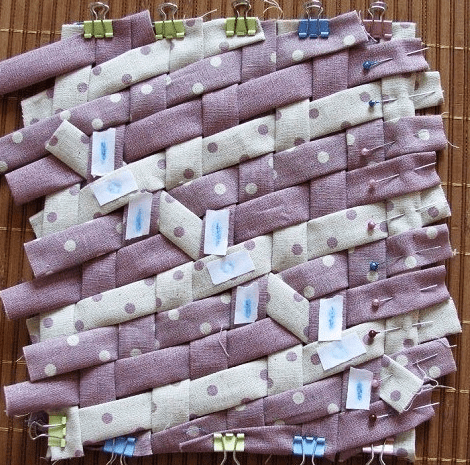


Bind the raw edges of the fabric with a similar strip of fabric, and you are ready to form a handbag, clutch, or use the piece to create textile home decor.


The Japanese are a creative nation, but they still have a long way to go to catch up with us😅