Tabletop Decor with a Scarf: Refreshing an Old Table
A step-by-step tutorial for decorating a tabletop with a scarf: take the old table apart and prep it, lay the scarf in place and glue it down with PVA from the center outward, fold and glue the edges under the tabletop, then apply at least 5 thin coats of yacht varnish, letting each one dry fully before the next.
IntermediateFree
Translated
Things you will learn
For this makeover you'll need an old table that needs repair, a large women's scarf, PVA wood glue, and quality yacht varnish.
Take the table apart, wash it well, strip the old finish, fill and sand any chips; coat the underside and legs with wood stain or colored varnish, and leave the top and edges ready for primer.
Lay the scarf on the tabletop centered, smooth out the folds, and tack the corners with small nails or pins, without pulling the fabric taut.
Brush PVA glue over the whole surface, right on top of the scarf, working from the center outward; you can thin the glue slightly if it's too thick.
Fold the scarf's edges under the table and glue them down too, then, once the glue is fully dry, apply at least 5 thin coats of yacht varnish, letting each one dry before the next.
What you'll get
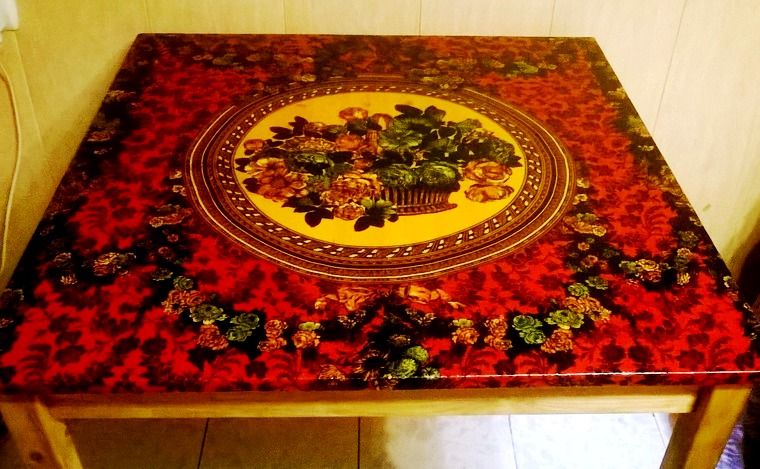
You'll get a refreshed tabletop with a striking scarf decor, securely glued down with PVA and protected by several coats of yacht varnish.
Materials and tools
Materials
An old table that needs repair, the base for this makeover; it's easier to work on if you take it apart first
A large women's scarf, the main decorative element — the scarf's pattern determines the finished tabletop's look
PVA wood glue, glues the scarf onto the tabletop; thin it slightly if it's too thick
Quality yacht varnish, applied in several thin coats over the glued scarf for protection and shine
Tools
Brush, needed to apply the PVA glue and the varnish
Small nails or pins, needed to tack the scarf's corners in place before gluing
Wood filler and sandpaper, needed to fix chips and uneven spots on the table before decorating
Preparation
Take the table apart and prep it
Take the table apart to make it easier to fix any flaws: wash it thoroughly, strip the old finish, fill and sand any chips.
Treat different surfaces differently
Coat the underside of the tabletop and the legs with wood stain or colored varnish, and leave the top and edges ready for a coat of primer — that's the part where the scarf will go.
Lay the scarf on the tabletop
The scarf goes on centered and gets smoothed out carefully before gluing.
Lay out and align the scarf
Lay the scarf on the tabletop and smooth out all the folds — check that it's centered.
Tack the corners
It's best to tack the fabric at the corners with small nails or pins. Don't pull the fabric taut — it just needs to lie flat.
Glue the scarf down with PVA
The glue goes on right over the scarf, working from the center outward.
Brush on the PVA
Take the PVA glue and brush it over the whole surface, right on top of the scarf. Work from the center outward. If the glue is too thick, you can thin it slightly.
Fold and glue the edges
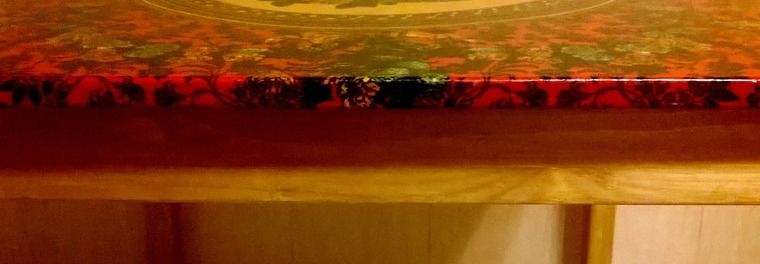
When you reach the scarf's edges, fold them under the table and glue them down carefully too. You should end up with a flat surface that wraps under the tabletop.
Apply the varnish and let it dry
The final stage is a protective varnish finish and full drying time.
Apply coats of yacht varnish
Wait for the glue to dry completely, then start applying the varnish in extremely thin coats. You'll need at least 5 coats total, letting each one dry before applying the next.
Let the table air out
The final drying and airing-out period is 3 to 4 days. After that, the table is ready to use.
Finish and variations
Finish
Use your refreshed table
Once it's fully dry and aired out, you can happily set dishes and treats on your refreshed table.
Variations
Practice on a small item first
If the scale of a whole table feels intimidating, try the same technique on a smaller piece first — a wooden box, for example — using a scrap of fabric, PVA glue, and ordinary spray acrylic varnish instead of yacht varnish.
The scarf slides out of place from the center of the tabletop while you're applying glue.
Likely cause
The scarf's corners weren't tacked with nails or pins before gluing began.
How to fix it
Tack the scarf's corners with small nails or pins before applying glue, so it doesn't shift.
Wrinkles or bubbles show up under the glue
Problem
After gluing, the scarf shows uneven spots, wrinkles, or air bubbles.
Likely cause
The fabric was pulled taut instead of just being smoothed flat.
How to fix it
Smooth the scarf out without pulling it taut — the fabric should lie flat on its own, not be stretched by force.
The PVA glue is hard to spread evenly
Problem
Overly thick glue doesn't spread evenly across the scarf with a brush.
Likely cause
The PVA was used undiluted even though its consistency was too thick.
How to fix it
If the PVA is too thick, thin it slightly with water before applying, so it spreads more easily with a brush.
The varnish coats come out uneven
Problem
After a few coats of varnish, the surface looks uneven or cloudy.
Likely cause
The next coat was applied before the previous one had fully dried, or the coats were applied too thickly.
How to fix it
Apply the varnish in extremely thin coats and wait for each one to dry completely before applying the next — you'll need at least 5 coats total.
Not sure which fabric works for this kind of decor
Problem
It's hard to decide which scarf or fabric to use for decorating a tabletop.
Likely cause
Not every type of fabric soaks up glue and bonds to the surface equally well.
How to fix it
Choose thin, natural fabrics like linen or cotton — synthetics and highly stretchy fabrics don't work for this technique.
Not sure whether yacht varnish is always necessary
Problem
It's unclear whether yacht varnish is strictly required for every project like this.
Likely cause
Yacht varnish isn't the only option suited to how the surface will actually be used.
How to fix it
If the table will only be used for decor, without heavy washing or daily wear, ordinary acrylic varnish (including spray versions) can be enough; yacht varnish is meant for surfaces that see heavy daily use.
?FAQ
What materials do you need to decorate a tabletop with a scarf?
An old table that needs repair, a large women's scarf, PVA wood glue, and quality yacht varnish.
How many coats of varnish do you need?
At least 5 thin coats, each one fully dried before applying the next.
How long does the finished table need to dry?
Final drying and airing out the smell takes 3 to 4 days after the last coat of varnish.
What kind of fabric works best for this decor?
Thin, natural fabrics like linen or cotton work best; synthetics and highly stretchy fabrics don't work.
Can you use something other than yacht varnish?
If the piece will only be used for decor without heavy washing, ordinary acrylic varnish (including a spray version) can be enough.
Your project
Log in to track your project, attach photos, and publish your result into the shared feed.
Listen to you and that's it, mom and wife just vanish for a long while))) I came to the forum to share my crochet experience, and all I find here are these "temptations." My own box actually fell out of the closet and broke apart – it was old anyway. Now I'm going to get obsessed with this whole thing, I was already dreaming up ideas last night 😁
When my son and I were doing egg decoupage for Easter, my husband just asked: picked up another idea from your website again? 😂 Creative ideas are incredibly contagious — coronavirus doesn't even come close ))
I promise you: the technique is really simple and approachable – even if you've never done anything like this before. I wrote about a similar makeover here: Decorating a Dresser in French Provençal Style . You're probably intimidated by the scale of the project, since a table is a big item after all. Try taking a scrap of fabric, some PVA glue, and decorating something smaller, like a wooden box – you can buy a plain wooden box for crafting very cheaply online. Swap the yacht varnish for regular acrylic (in a sprayShow full quoteCollapse
I promise you: the technique is really simple and approachable – even if you've never done anything like this before. I wrote about a similar makeover here: Decorating a Dresser in French Provençal Style. You're probably intimidated by the scale of the project, since a table is a big item after all. Try taking a scrap of fabric, some PVA glue, and decorating something smaller, like a wooden box – you can buy a plain wooden box for crafting very cheaply online. Swap the yacht varnish for regular acrylic (in a spray can), and you'll be all set ))
Listen to you and that's it, mom and wife just vanish for a long while))) I came to the forum to share my crochet experience, and all I find here are these "temptations." My own box actually fell out of the closet and broke apart – it was old anyway. Now I'm going to get obsessed with this whole thing, I was already dreaming up ideas last night 😁
This is fantastic, and such a huge amount of work! Of course a lot depends on the scarf, and the decor here is really well chosen. I imagine anyone who does decoupage could handle this, but for my inexperienced hands it feels out of reach — the transformation is impressive, though!
I promise you: the technique is really simple and approachable — even if you've never done anything like this before. I wrote about a similar makeover here: Decorating a Dresser in French Provençal Style. You're probably intimidated by the scale of the project, since a table is a big item after all. Try taking a scrap of fabric, some PVA glue, and decorating something smaller, like a wooden box — you can buy a plain wooden box for crafting very cheaply online. Swap the yacht varnish for regular acrylic (in a spray can), and you'll be all set ))

 IntermediateFree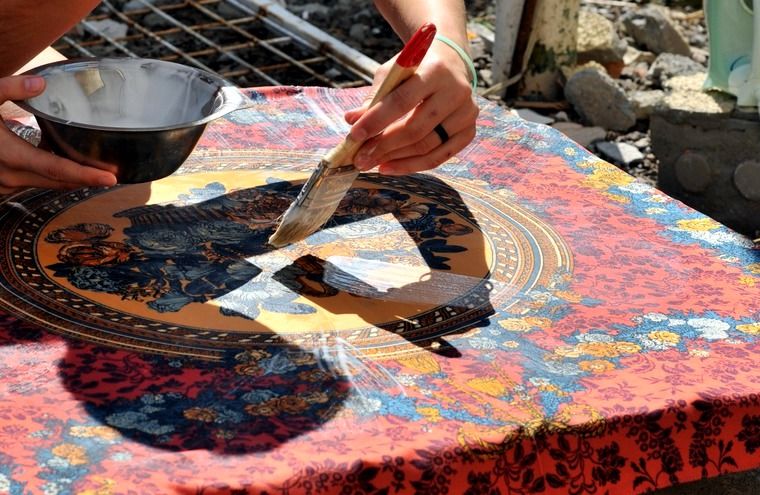


I promise you: the technique is really simple and approachable – even if you've never done anything like this before. I wrote about a similar makeover here: Decorating a Dresser in French Provençal Style . You're probably intimidated by the scale of the project, since a table is a big item after all. Try taking a scrap of fabric, some PVA glue, and decorating something smaller, like a wooden box – you can buy a plain wooden box for crafting very cheaply online. Swap the yacht varnish for regular acrylic (in a sprayShow full quoteCollapse