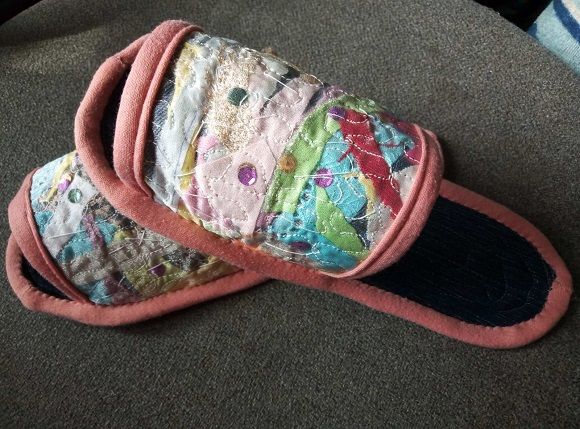
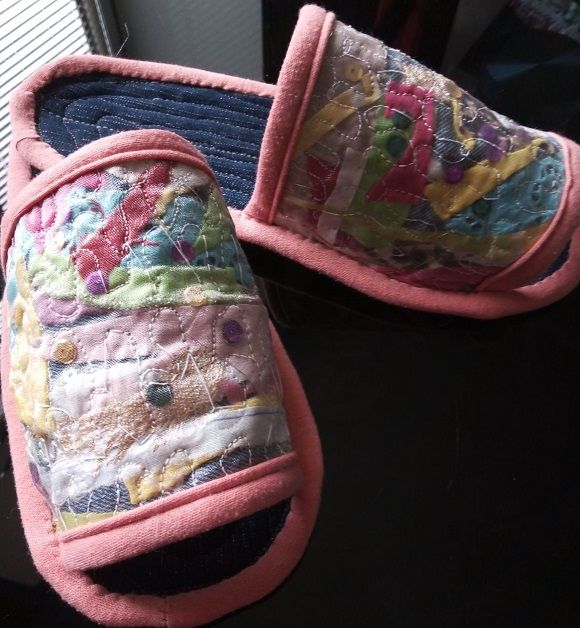
How to Sew Home Slippers "from Nothing": Using Fabric Scraps
A tutorial for home slippers made from fabric scraps: assemble a padded sole from felt, batting, and denim, make a patchwork top using the "pizza" technique, join the pieces, and finish the edge with a knit binding.
Beginner2 hrFree
Translated
Things you will learn
You don't have to sew home slippers from faux leather, soft felt, or warm faux fur — leftover fabric scraps and batting scraps work too, and in just a couple of hours you'll get a unique pair with a one-of-a-kind design.
The "pizza" technique lets you use up the smallest, most useless fabric scraps that couldn't be put to any other use.
For the sole you'll need sturdy felt or wool coating, batting, and a scrap of denim from old jeans; for the top — soft fabric about 20 by 40 cm, bits of fabric, sequins, glitter, leftover knitting yarn, and sheer fabric of the same size (organza, an old chiffon scarf, tulle, mesh, or voile); for the binding — knit tape 5 cm wide, an old T-shirt works well for this.
Trace your foot onto paper with a small 1 cm seam allowance for the pattern, cut 2 mirror-image sole pieces from felt or wool coating and 2 more from denim, layer them (felt, batting, denim), pin them together, and quilt from the edges toward the center, trimming away excess batting and fabric.
For the top, cut 2 rectangles about 10 by 20 cm, scatter scraps, sequins, and yarn bits on top, cover with sheer fabric, and machine-quilt it; then fit the top to the sole, shape it, sew a strip of knit binding around the top of each slipper, sew the binding on all the way around the sole to secure the top, and hand-stitch it down with invisible stitches.
What you'll get
You'll get a unique pair of home slippers with a patchwork "pizza"-technique top and a soft, padded sole.
Materials and tools
Materials
Sturdy felt or wool coating, for the sole
Batting, for the sole and padding
A scrap of denim from old jeans, for the sole
Soft fabric, about 20 by 40 cm, for the top
Bits of bright fabric, sequins, glitter, leftover yarn, any scraps you have on hand for the "pizza" filling
Sheer fabric, 20 by 40 cm — organza, an old chiffon scarf, tulle, mesh, or voile
Knit binding tape, 5 cm wide; an old T-shirt works well
Paper for the pattern
Tools
Pins
Sewing machine
Scissors
Needle, for hand-stitching the binding
Preparation
Make the pattern
Trace your foot onto a sheet of paper with a small (1 cm) seam allowance.
Assemble the padded sole
Cut the sole pieces and layer them together.
Cut the sole pieces
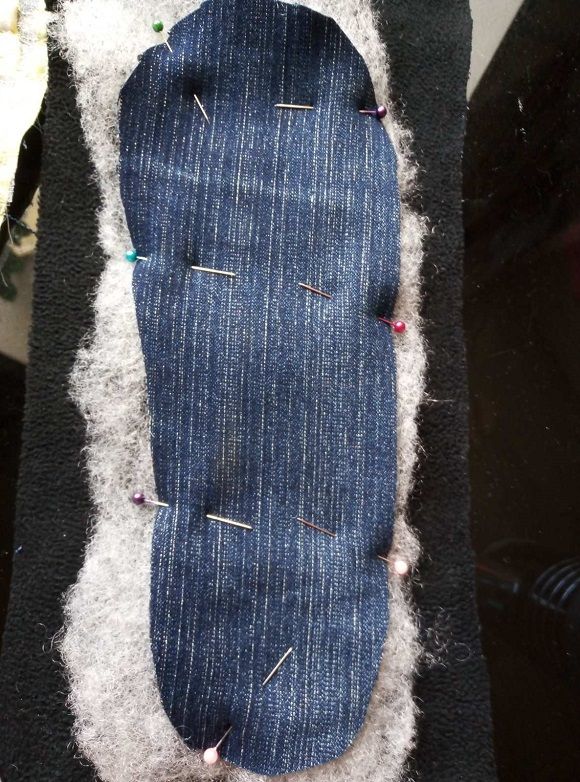
Using your finished pattern, cut 2 mirror-image pieces from felt or wool coating, and 2 more from denim. Layer them in this order: the felt piece (the bottom of the insole), a layer of batting, then the denim piece. Pin them together.
The sole layers before sewing
Quilt the sole
Quilt from the edges toward the center. Trim away any excess batting and fabric.
A pair of padded soles
Make the patchwork "pizza" top
Assemble the top of the slipper from scraps and decorative bits sandwiched between fabric layers.
Assemble the "pizza" piece and fit it to your foot
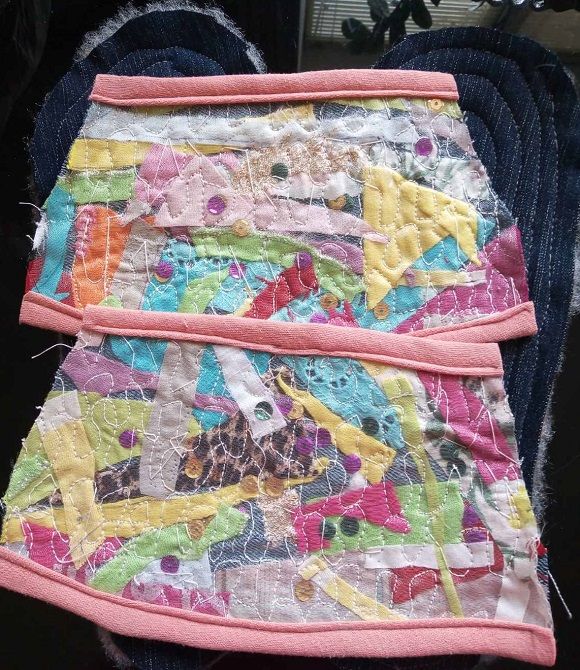
Cut 2 rectangles about 10 by 20 cm each from soft fabric. Scatter scraps, sequins, yarn bits — anything you want to use for the "pizza" — on top, cover with sheer fabric, and machine-quilt it. Next, do a fitting: pin the top to the sole and adjust it to your foot. I shaped the pieces like a trapezoid, tapering them slightly toward the bottom. Trim the top of both slippers with a strip of knit binding. The fabric stretches well, so you can ease it in slightly if needed.
The patchwork top piece
Attach the top to the sole
Pin the top to the sole and try the slippers on.
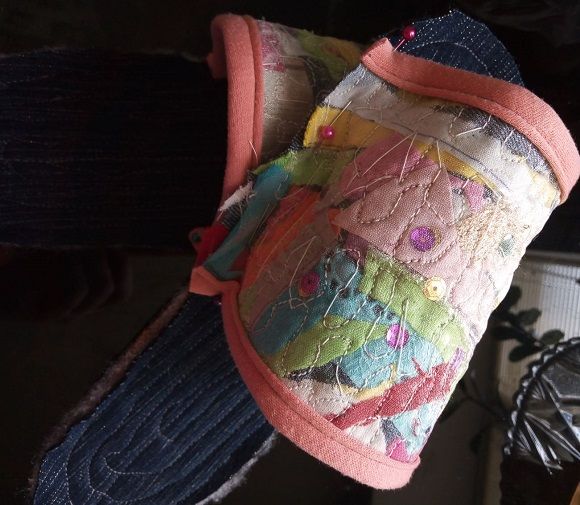
Pin the top to the sole with the raw edges out
Pin the top of the slippers to the sole with the raw edges facing out, and try them on.
The top with a patchwork pattern
Finish the edge with knit binding
Sew on and hand-stitch the binding to secure the top and finish the edge.
Stitch the binding on all the way around
Baste the knit binding in place, then stitch it on by machine all the way around the sole, securing the top piece at the same time.
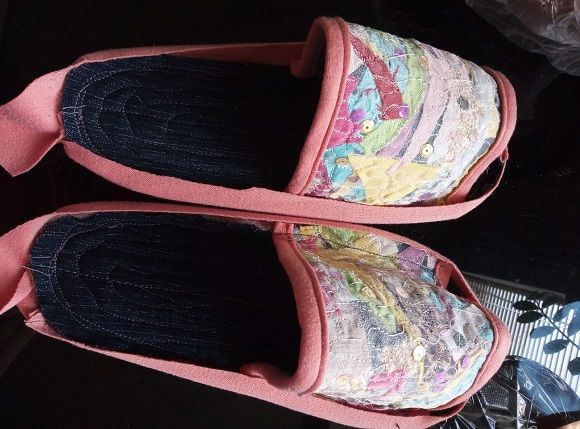
A pair of slippers, top view
Hand-stitch the binding down
Fold the binding to the right side and hand-stitch it down with invisible stitches.
A slipper held in handSlippers made from scraps, with a pink binding
Finish and variations
Finish
Your slippers made from fabric scraps are ready
Your slippers are ready! The author sewed several guest pairs for friends, a sister, and a daughter — this simple way of sewing home footwear will come in handy for you too.
Variations
Sew a closed-toe version
The author chose an open-toe style since it was heading into spring and warm slippers weren't especially needed, but you can sew closed-toe footwear instead — it's entirely up to you.
Use any scraps you have
Bits of bright fabric, sequins, glitter, leftover knitting yarn — any scraps you have on hand work for the "pizza" filling.
After quilting from the edges toward the center, the sole wrinkles or gathers into puckers.
Likely cause
The felt, batting, and denim layers weren't pinned evenly across the whole area before quilting.
How to fix it
Pin all three layers evenly across the whole surface before quilting, and work the stitching lines from the edges toward the center gradually rather than in quick jumps.
The "pizza" filling shifts under the sheer fabric
Problem
After quilting, the decorative scraps and sequins have shifted to one side, leaving empty patches.
Likely cause
The sheer fabric was only pinned around the edges before quilting, with no pins in the middle.
How to fix it
Before quilting, pin the sheer fabric not just around the edges but at a few points in the middle too, so the filling doesn't shift.
The binding ripples after being sewn on
Problem
After stitching the knit binding on all the way around, the edge of the sole ripples instead of lying flat.
Likely cause
The binding was stretched too much around the curves, without easing the fabric in slightly.
How to fix it
Ease the knit binding in slightly around curved sections, since the fabric stretches well and this helps it lie flat all the way around.
?FAQ
What can you sew the slipper sole from?
Sturdy felt or wool coating, batting, and a scrap of denim from old jeans.
What size should the pieces for the top be?
About 20 by 40 cm for the soft fabric and the sheer fabric, and about 10 by 20 cm for the "pizza" rectangles.
What seam allowance do you use for the foot pattern?
A small allowance of about 1 cm.
How wide should the knit binding be?
5 cm wide; an old T-shirt works well.
Can you sew closed-toe slippers with this tutorial?
Yes — the open-toe style was just the author's preference; closed-toe footwear can be sewn the same way.
Your project
Log in to track your project, attach photos, and publish your result into the shared feed.

 Beginner2 hrFree