A tutorial for sewing a "Chopsticks" placemat: cut 4 squares, insert 2 freeform diagonal strips of contrasting fabric into each one, trim the pieces to a template and join them into a single block, layer a "sandwich" with backing and batting, quilt around the perimeter and along the main seams, then bind the edge.
Beginner1 hr 30 minFree
Translated
Things you will learn
You can sew a potholder or hot pad from the scrappiest fabric leftovers; the "Chopsticks" placemat is sewn in a freeform technique and doesn't require precise measuring, so it suits anyone who loves improvisational sewing.
For the placemat, you'll need fabric in a few colors (such as knit fabric and silk — scraps from old clothes work well), plus backing fabric and batting or another filler sized to your hot pad.
The block is made of 4 pieces — squares measuring 10 by 10 cm; you can also put together a block from 12 by 12 cm or 15 by 15 cm pieces, or make a long placemat or a large mat from 9 or more pieces.
On each square, draw a freeform line on the right side, pin a strip of contrasting fabric along it, and stitch it down; then cut the piece exactly along the line, fold back the stitched-on piece, trim it to a 1.5 cm seam allowance, sew the cut-off corner back on, and press the seams inward; then draw a second line (at an angle to the first, parallel to it, or even crossing it) and repeat the whole process.
Once all 4 finished pieces are trimmed to a template, arrange them in whatever orientation works best (you can turn each square any way you like) and join them into a placemat; then layer a "sandwich" of backing, batting, and the patchwork top, quilt around the perimeter and crosswise along the main seams, and bind the edge, sewing it on from the right side, folding it to the wrong side, and hemming it by hand or machine.
What you'll get
You'll get a light, unusual "Chopsticks" placemat made from a patchwork block with freeform strips, ready to brighten up any kitchen.
Materials and tools
Materials
Fabric scraps in a few colors, such as knit fabric and silk — leftovers from old clothes work well
Backing fabric, such as a scrap of white cotton muslin
Batting or another filler, sized to match your hot pad
Binding, used to finish the edge of the finished placemat
Tools
Sewing machine, for sewing the pieces, quilting, and finishing the edge
Pins, for pinning the pieces together before sewing
A square template, for trimming and aligning the finished pieces
Iron, for pressing the seams
Scissors, for cutting and trimming the pieces
Preparation
Gather your materials
For the placemat, you'll need fabric in a few colors — such as knit fabric and silk (leftovers from old clothes work well) — plus backing fabric and batting or another filler sized to your hot pad.
Cut the squares for the block
The block is made of 4 pieces — squares measuring 10 by 10 cm. You can put together a block from 12 by 12 cm or 15 by 15 cm pieces, or make a long placemat or a large mat from 9 or more pieces.
Add the strip insets to a square
On each square, a freeform line is drawn and a strip of contrasting fabric is sewn in along it.
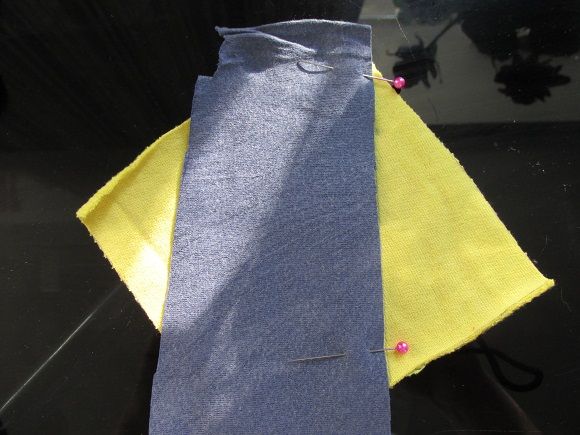
Draw a line and pin on the strip
Cut 4 pieces, 10 by 10 cm — two from one fabric, two from another. Draw a freeform line on the right side — this will be where our "chopstick" sits. Pin a strip of contrasting fabric along the line and stitch it down.
The strip for the inset
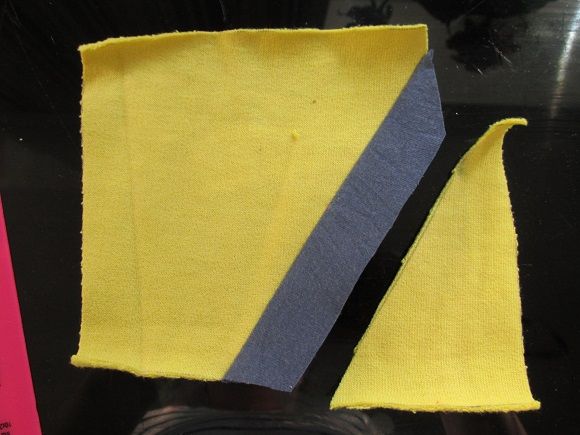
Cut the piece and sew in the corner
Cut the piece into 2 parts, exactly along the line. Fold back the stitched-on piece, trim it to a 1.5 cm seam allowance, and sew the cut-off corner back on. Fold the seams inward and press.
A square with the strip sewn in
Repeat with a second line
Draw a second line. It can run at an angle to the first one, parallel to it, or even cross it. Repeat everything described above.
The square after the second inset
Assemble the block from 4 pieces
The finished pieces are trimmed to a template and joined into a single block.
Trim the pieces and choose their layout
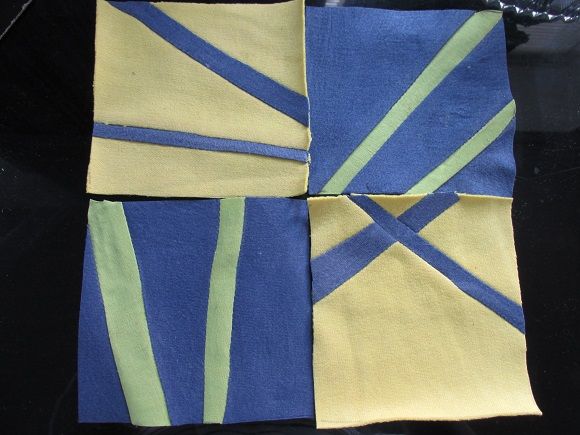
Work through all 4 pieces this way. Align them with the template and trim away the excess. Choose a good position for each square — you can turn them any way you like.
Four finished blocks
Join the pieces into a placemat
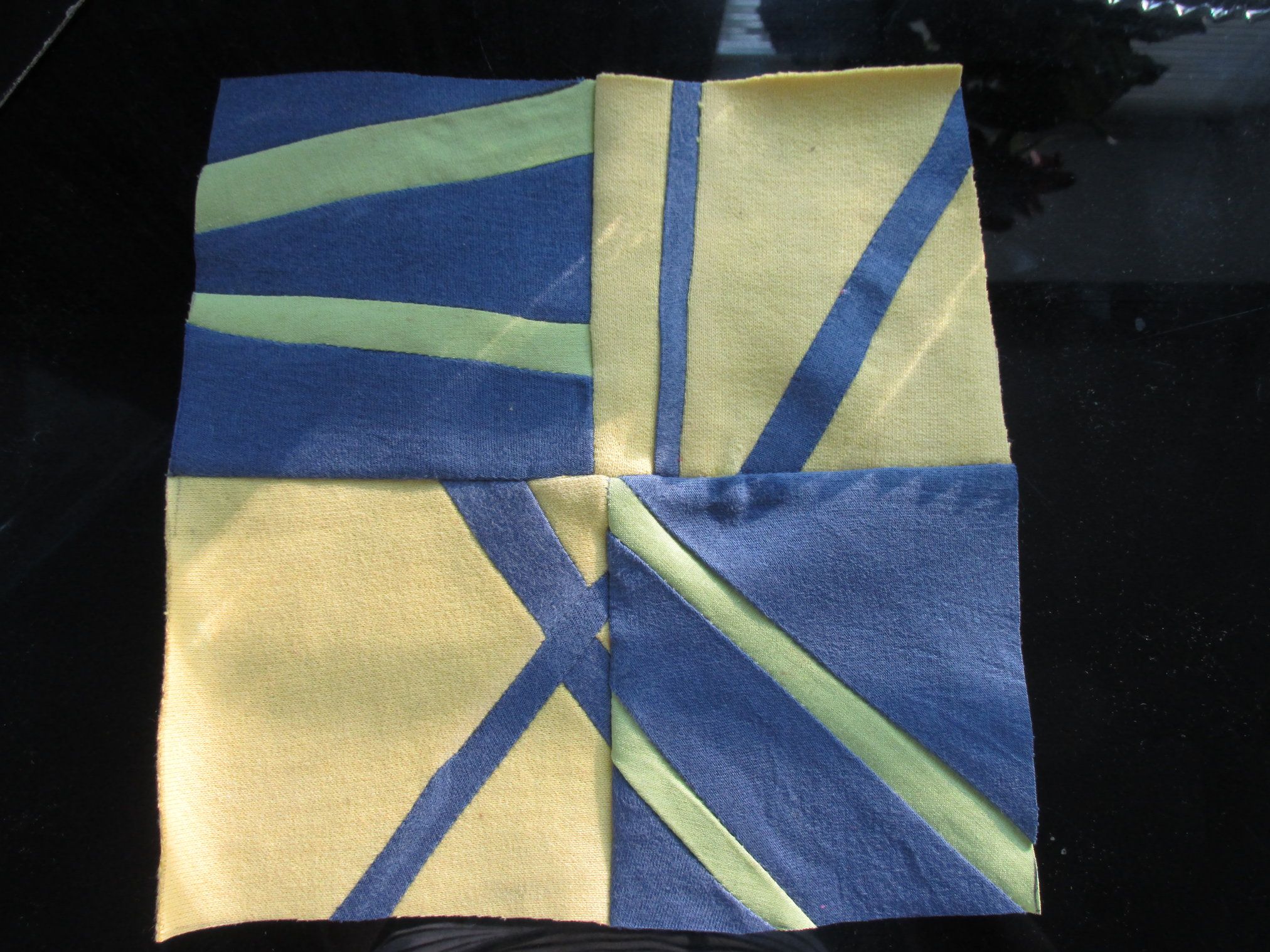
Join the 4 pieces into a single placemat.
The assembled placemat top
Layer and quilt the "sandwich"
The patchwork top, batting, and backing are layered together and quilted.
Layer the "sandwich"
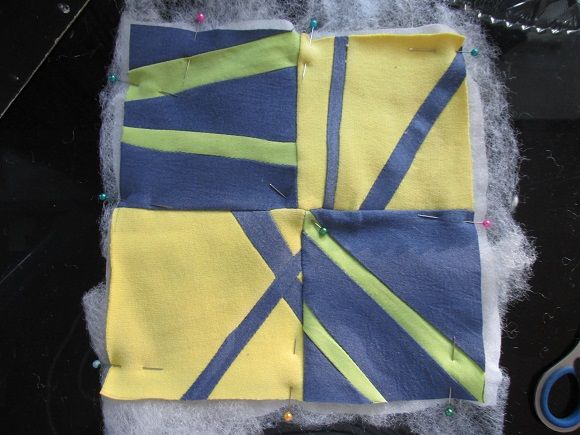
Make a "sandwich": backing fabric (such as a scrap of white cotton muslin), batting, and the sewn patchwork top. Pin everything together.
The placemat with backing and batting
Quilt around the perimeter and seams
Stitch around the perimeter, and crosswise along the main seams.
Finish the edge with binding
The finished placemat is bound with contrasting binding.
Sew on and hem the binding
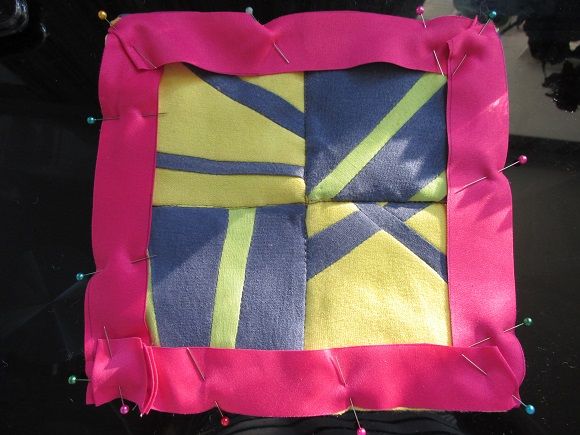
Finish the edge with binding — a bright knit fabric works well, peeking out just slightly from under the edge to freshen up the piece. Sew the binding on from the right side, fold it to the wrong side, and hem the edge by hand. You can also do this by machine.
The finished placemat with pink binding
Finish and variations
Finish
Your finished placemat will brighten up the kitchen
Our light, unusual placemat is ready. It'll brighten up any kitchen and help make your home feel cozier.
Variations
Make a Japanese-style version
If you want to make a mat like this in a Japanese style, think through your color scheme and choose a combination of black, red, and white shades for an Eastern theme.
Assemble a block from more pieces
You can put together a block from 12 by 12 cm or 15 by 15 cm pieces, or make a long placemat or a large mat from 9 or more pieces.
After sewing the cut-off corner back on, the fabric puckers or bunches up at the seam.
Likely cause
The piece wasn't trimmed to exactly a 1.5 cm seam allowance before sewing on the corner, leaving too many layers of fabric at the seam.
How to fix it
Trim the folded-back piece to exactly a 1.5 cm seam allowance before sewing the cut-off corner back on — this avoids extra bulk at the seam.
The finished squares come out different sizes
Problem
After adding the strips to all 4 pieces, the squares end up different sizes and don't line up when assembling the block.
Likely cause
The pieces weren't trimmed to a single template after all the strips were added.
How to fix it
Once all the strips are added, be sure to align all 4 pieces with a single template and trim away the excess — this guarantees squares of the same size.
The layers of the "sandwich" shift while quilting
Problem
While quilting, the backing, batting, and patchwork top shift relative to each other.
Likely cause
The layers weren't pinned securely enough before quilting.
How to fix it
Before quilting, pin all three layers thoroughly across the whole surface, not just around the edge.
?FAQ
What fabric works best for this placemat?
Any leftover scraps from old clothing — such as knit fabric and silk; the main thing is that the colors contrast with each other.
What size squares does the block need?
10 by 10 cm; you can also put together a block from 12 by 12 cm or 15 by 15 cm squares.
What seam allowance do I need when sewing in the cut-off corner?
1.5 cm.
How is the finished placemat quilted?
Stitch around the perimeter, and crosswise along the main seams.
How do I make this placemat in a Japanese style?
Choose a combination of black, red, and white shades for an Eastern theme.
Your project
Log in to track your project, attach photos, and publish your result into the shared feed.

 Beginner1 hr 30 minFree