How to Make a Camouflage Net: Materials and 3 Weaving Methods
How to make a textile camouflage net: choosing a nylon or fishing-net base, preparing natural-colored fabric scraps, setting up a net on a 4-5 m² work area, and using three fill techniques — the snake weave, fringe, or a mixed method.
BeginnerFree
Translated
Things you will learn
For the base, nylon netting is best since it's sturdier; ordinary fishing net also works.
Choose fabric in natural colors — gray, brown, khaki, olive — and white for winter if there's snow.
It's important that the fabric doesn't flare up or melt; leftover scraps, offcuts, and rags of any size will do.
The source material covers three fill techniques: the snake weave, fringe, and a mixed method.
What you'll get
You end up with a mesh base filled in with fabric strips or small tied scraps. The material covers the craft technique for weaving and preparing materials, but doesn't assess how effective the finished net is or give instructions for using it in real concealment scenarios.
Materials and tools
Materials
Netting for the base, nylon netting works best; ordinary fishing net is fine too
Fabric scraps or rags in suitable colors, gray, brown, khaki, olive; white for winter if there's snow
Paint for coloring the net, optional, if you have the time and want to color the net further
Tools
A wooden frame or another way to secure the base, the base needs to be stretched or fixed in place before weaving
A 4-5 m² work area, the source material specifies this as the workspace for weaving
Scissors, for cutting strips and making slits in short strips
Brushes, only needed if you're using paint
Files and resources
Video on the snake weaving techniqueThe video from the source material shows the technique for weaving a strip through the netting.Video on the snake weaving technique
Video on the fringe techniqueThe video from the source material shows tying small scraps onto the net's knots.Video on the fringe technique
Preparation
Scope and safety
Treat this material as a textile tutorial on preparing the netting and fabric scraps. Don't add claims that the finished net will reliably conceal anything — the source doesn't include any effectiveness testing.
Set up the base
For weaving, set up a work area about 4-5 m². Stretch the netting onto a wooden frame or secure it another way so it's easy to work with.
Prepare the fabric
Gather leftover fabric, offcuts, or rags in natural colors. An important condition from the source: the fabric must not flare up or melt.
Base and Colors
Choose your netting
Nylon netting works best — bases made from it come out sturdier. If you don't have nylon netting, ordinary fishing net will do.
The base onto which fabric strips or scraps are attached.
Pick natural fabric colors
The source material lists gray, brown, khaki, olive, and white for winter if there's snow. The pieces can be any size — any leftover scraps or offcuts will work.
Check the fabric
The source specifically notes: the fabric must not flare up or melt.
Decide whether you need paint
If you have the time and want to, you can also use paint to color the net. In that case, prepare some brushes too.
The Snake Technique
In this technique, the base is filled in with long fabric strips.
Cut strips 5-6 cm wide
For the snake technique, you need fabric strips 5-6 cm wide and 30-100 cm long. If your strips are short, you can join them into one longer strip.
Join short strips using slits
Fold the end of the first strip in half and cut a slit along the fold. Make the same slit in the second strip, then join the strips by threading one through the other's slit loop.
Weave the strip through the mesh cells
Next, work the snake weave. The exact hand movement for threading the strip is covered in a separate video in the source material, so the text here records the strip prep and the technique itself.
Filling the base with fabric strips.
The Fringe Technique
This method relies on small scraps tied onto the net's knots.
Tie scraps onto every knot
For the fringe technique, you need small pieces of fabric. Tie them onto every knot of the net; once you have enough of these scraps, they add bulk and cover the space under the netting.
The Mixed Technique and Finishing
Combine the snake weave and knots
The third option from the source is a mixed method: first work the snake weave, then add knots.
Roll up the finished net carefully
The final principle from the source is to match the fill pattern to the natural surroundings. Roll the finished net up carefully.
No promises about results
The text shouldn't promise reliable concealment: the source material doesn't provide any tests, testing conditions, or effectiveness criteria.
Finish and variations
Finish
Roll the net up
Once filled in, the base is carefully rolled up. This is the last step given in the source material.
Variations
Snake weave only
Use long fabric strips 5-6 cm wide and 30-100 cm long.
Fringe only
Fill the knots with small pieces of fabric for a bulkier surface.
The netting stretches or might tear while you're working.
Likely cause
You chose a weak base, or it isn't secured well.
How to fix it
Per the source, nylon netting is better since it's sturdier. Before weaving, stretch the base onto a frame or fix it securely another way.
The fabric isn't safe to use
Problem
The scraps could flare up or melt.
Likely cause
The material was chosen by color alone, without checking the fabric's properties.
How to fix it
The source specifically requires choosing fabric that doesn't flare up or melt. It's best to set aside any such scraps before you start.
The strips are too short for the snake weave
Problem
The strip runs out quickly and doesn't allow continuous weaving.
Likely cause
You're using short offcuts.
How to fix it
Join short strips using slit loops: fold the end in half, cut a slit along the fold on both strips, and thread one through the other.
The net looks flat
Problem
The fill doesn't add any volume.
Likely cause
Only sparse strips were used, without extra knots.
How to fix it
Add the fringe technique: small scraps tied onto the net's knots add bulk once there are enough of them.
?FAQ
What kind of netting should I use for the base?
Nylon netting is best — the source notes that these bases are sturdier. If you don't have it, ordinary fishing net will do.
What fabric do I need for filling it in?
Leftover scraps, offcuts, and rags in natural colors work well: gray, brown, khaki, olive, white for winter if there's snow. It's important that the fabric doesn't flare up or melt.
What size strips do I need for the snake weave?
The source specifies strips 5-6 cm wide and 30-100 cm long. Short strips can be joined using slit loops.
What weaving methods does this material cover?
Three options are covered: the snake weave, fringe, and a mixed method where you work the snake weave first and then add knots.
Is paint required?
No. The source says paint and brushes can be used as an extra step, if you have the time and want to color the net.
Your project
Log in to track your project, attach photos, and publish your result into the shared feed.
We're weaving a Kikimora suit. We thread strips about 20 cm long and 5-8 cm wide through the mesh cell and tie a knot. The tails go on in several rows and overlap each other, so there are no gaps anywhere.

 BeginnerFree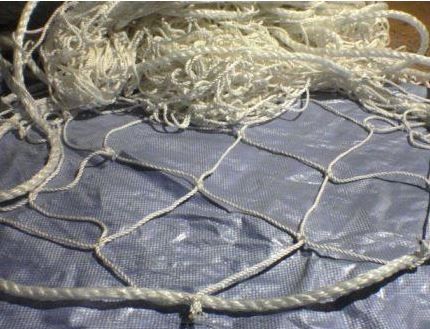


We're weaving a Kikimora suit. We thread strips about 20 cm long and 5-8 cm wide through the mesh cell and tie a knot. The tails go on in several rows and overlap each other, so there are no gaps anywhere.