How to Fix Pants: Disguise a Hole and Make It Invisible
Here's how to invisibly close a small hole in pants: prep a fabric patch and fusible interfacing, mix chopped-up thread with fabric glue, and set the patch with an iron through paper.
BeginnerFree
Translated
Things you will learn
This method works not just for pants but for any wool or fine-fabric clothing, where topstitching, a decorative seam, or a regular patch don't look great.
Don't throw away the thread you trim around the hole — chop it up and mix it 1:1 with dry fabric glue to disguise the patch's outline.
Cut the fabric patch twice the size of the hole, fit it using chalk or a sliver of soap, then trim it almost exactly to size, leaving 1 mm all around.
Set the patch with a hot iron through tracing paper or parchment paper for 15 seconds, without moving the iron.
What you'll get
An invisible patch over the hole in your pants or other wool clothing — the outline is disguised with chopped-up thread, and the patch is held firmly in place with a fusible base.
Materials and tools
Materials
A scrap of matching fabric, Taken from a hem allowance on the pant leg, or from a fabric swatch that often comes with the garment along with a spare button and snap.
Fusible interfacing, A scrap of fusible interfacing is placed on the wrong side, right over the hole.
Dry fabric glue, Mixed 1:1 with the chopped-up thread trimmed around the hole.
Chalk or a sliver of soap, For marking the exact patch size against the scrap held on the wrong side.
Tracing paper or parchment paper, Placed on top before ironing, to protect the patch and the iron.
Tools
Manicure scissors, For carefully trimming the loose threads around the hole; you'll need those same threads later.
Scissors, For cutting the patch and chopping up the thread.
Pins, For pinning the fusible interfacing scrap in place.
Iron, For bonding the patch through the paper; it needs to be hot.
Trim the threads around the hole
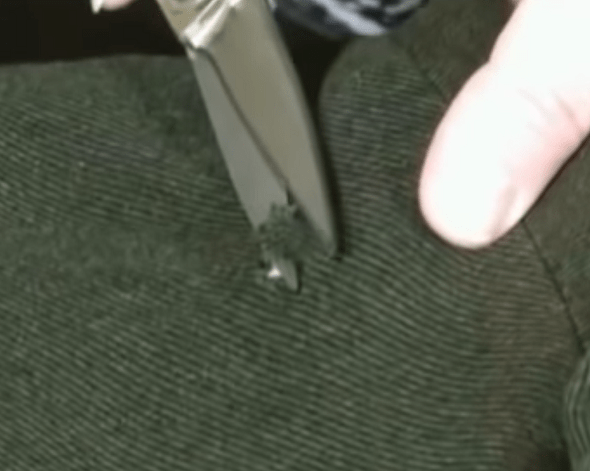
Carefully trim the loose threads
First, carefully trim away all the loose threads around the hole with manicure scissors — but don't throw them away!
Cut the patch to size
Cut a patch twice the size of the hole
Next, cut a scrap twice the size of the hole from the hem allowance on the pant leg, or from a fabric swatch that often comes with the garment along with a spare button and snap.
Fit the size with chalk or a sliver of soap
Hold it against the wrong side and rub it with a sliver of soap or chalk to mark the size. Trim the patch almost exactly to that size, leaving about 1 mm all around.
Prep the fusible base and the thread mix
Pin the fusible interfacing on the wrong side
Cut a scrap from the fusible interfacing, place it on the wrong side right over the hole, and pin it in place.
Mix the chopped-up thread with the glue
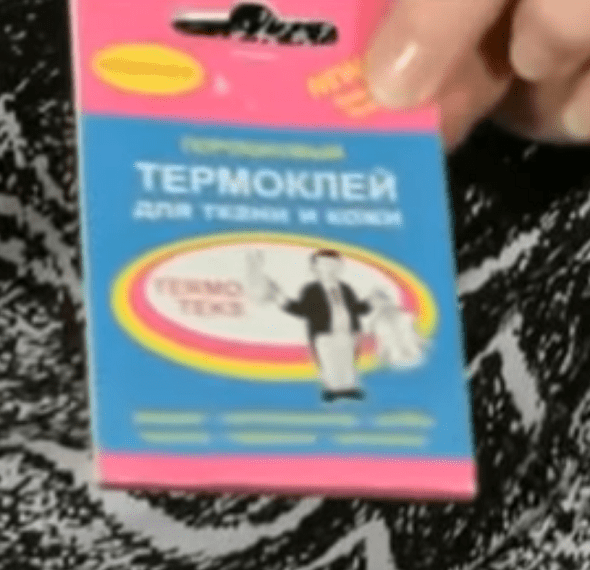
Chop up the threads you trimmed earlier with scissors and mix them 1:1 with dry fabric glue. If you don't have that kind of powder, you can buy fusible web instead, chop it up finely, and mix it with the thread the same way.
Set the patch with an iron
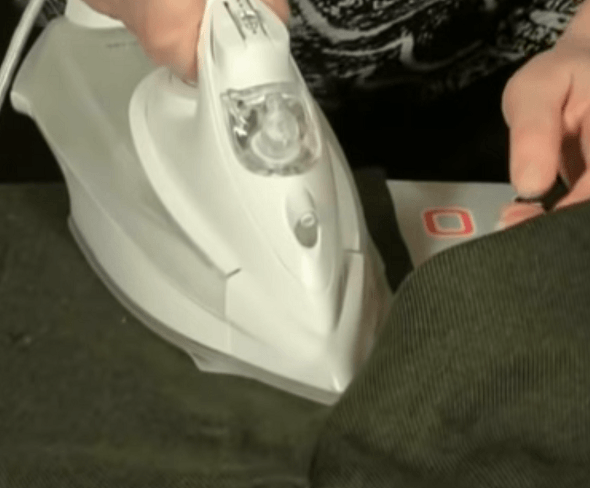
Iron the patch through paper
Sprinkle on the mixture, lay the patch on top, lining up the pattern, then cover it with tracing paper or parchment paper, and press with a hot iron (without shifting it!) for 15 seconds.
Hold the iron longer if needed
This bonds the patch firmly to the fusible base, while the finely chopped thread hides the outline. If the hole isn't fully disguised on the first try, hold the iron and paper in place for another 5-10 seconds.
Finish the repair
Hand-wash the garment
Hand-wash the finished garment to rinse out any chalk marks and remove any bits of thread that didn't bond with the fusible glue.
Finish and variations
Finish
Check the result after washing
After hand-washing, make sure the patch holds firmly and its outline doesn't stand out against the rest of the fabric.
Variations
Fusible web instead of powder
If you don't have dry fabric glue, use fusible web instead: chop it up finely and mix it with the chopped-up thread the same way as the powder.
For any wool or fine fabric
This method works well not just for pants, but for any wool or fine-fabric clothing where topstitching or a decorative seam wouldn't look great.
After ironing, you can see a line between the patch and the fabric.
Likely cause
There wasn't enough chopped-up thread, or the glue mixture wasn't spread evenly around the outline.
How to fix it
Spread the mixture of chopped-up thread and glue evenly over the whole area around the hole before covering it with the patch.
The patch doesn't hold well after ironing
Problem
The patch's edges come unstuck once it cools.
Likely cause
The iron wasn't held in place long enough, or the fusible base didn't fully melt within 15 seconds.
How to fix it
Hold the hot iron on the paper for another 5-10 seconds without shifting it, so the fusible base sets completely.
Chalk marks are left on the fabric after the repair
Problem
White marks from the chalk or soap are visible where the patch is.
Likely cause
The garment wasn't hand-washed after the patch was set.
How to fix it
Hand-wash the finished garment — this rinses out the chalk marks and removes any thread that didn't bond with the fusible glue.
?FAQ
What makes this hole-repair method different?
Unlike topstitching, a decorative seam, or a regular patch, this method makes the repair almost invisible — especially on wool and fine fabric.
Why keep the trimmed threads?
You chop them up and mix them with fabric glue — that mixture is exactly what disguises the patch's outline.
What size should the patch be?
Cut it twice the size of the hole, then trim it almost exactly to size, leaving 1 mm all around, after marking the exact size with chalk or soap on the wrong side.
How long do I hold the iron on the patch?
15 seconds, without shifting the iron; if the hole isn't fully disguised, hold it for another 5-10 seconds.
Is there anything to do after the repair?
Yes, hand-wash the finished garment to rinse out the chalk marks and remove any thread that didn't bond with the fusible glue.
Your project
Log in to track your project, attach photos, and publish your result into the shared feed.

 BeginnerFree