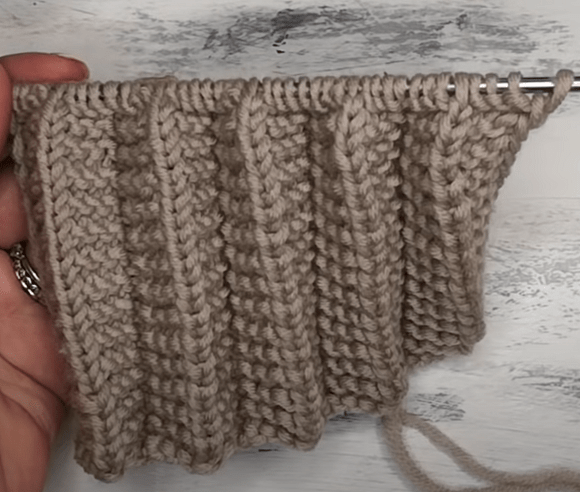
The source presents a textured, reversible pleated pattern for a knitted skirt or dress. The fabric is worked in knit and purl stitches, with the pleats formed in garter stitch. It gives the Sahara yarn composition, a cast-on rule for 2.5 cm-wide pleats, and a written sequence for the first three rows; however, the pattern repeat notation needs to be checked on a swatch.
BeginnerFree
Translated
Things you will learn
For 2.5 cm-wide pleats, the author recommends casting on a multiple of 8 stitches, plus 2 edge stitches.
The pleated pattern uses knit and purl stitches; both sides of the fabric look the same.
For a style that widens toward the hem, the source suggests evenly reducing the stitch count within one pattern repeat.
Fabric in the Pleated Pattern
Reversible knitted fabric with vertical pleats of varying widths and depths for a skirt or dress.
Materials and tools
Materials
Sahara yarn, Fiber content stated by the author: 70% viscose and 30% linen. Yarn quantity is not given.
Tools
Knitting needles, The needle size is not specified in the source.
Preparation
Knit a swatch
Before calculating the garment, knit a swatch in the pattern. The author used Sahara yarn (70% viscose, 30% linen).
Pleated pattern
The author recommends beginning with a swatch to choose the pleat width and verify the stitch sequence.
Cast on stitches for a swatch
For 2.5 cm-wide pleats, cast on a multiple of 8 stitches and add 2 edge stitches.
Work the first three rows
Row 1: knit all stitches. Row 2: knit 3, knit 1 — the crest of the pleat, knit 3, purl 1 — the inside of the pleat, then knit 3. Row 3: knit 3, purl 1, knit 3, knit 1, then knit 3. The author’s original notation is retained; its relationship to the stated pattern repeat should be checked on a swatch.
Check the pattern repeat
The text states a multiple of 8 stitches plus 2 edge stitches and gives row sequences that are not marked as a complete repeat. Before calculating the garment, knit a swatch and make sure the pleats form symmetrically.
Repeat rows two and three
Continue by repeating rows 2 and 3. The pleat in this pattern is worked in garter stitch, so the right and wrong sides of the fabric look the same.
Finish and variations
Finish
Use the pattern in a garment
After checking the swatch, repeat the pattern until the piece reaches the desired length.
Variations
A style that widens toward the hem
For a skirt or dress that widens toward the hem, the author suggests evenly reducing the stitch count within one pattern repeat so the pleat gradually narrows toward the waist.

 BeginnerFree