Dog Sweater on Two Needles: Measurements and Knitting
A step-by-step guide to knitting a sweater for a small dog: taking measurements, starting from the lower center section, shaping the armholes, the back, the neckband, the bottom trim, and optional sleeves.
IntermediateFree
Translated
Things you will learn
The source is sized for a small dog: back length (L) 30 cm, chest circumference (C) 30-32 cm, neck circumference (N) 20-25 cm, front-leg gap (G) 10-12 cm.
The piece starts from the lower center section: cast on 25 stitches, and the first extra row isn't counted.
The armhole starts on a purl row: in row 10, bind off 10 stitches, then in row 23, cast on 10 stitches again.
The second half of the sweater is knitted as a mirror image: decreases are worked in the same places where there were increases.
What You'll Make
The result is a warm knitted garment for a small dog: a basic vest with open armholes, or a sweater with short sleeves. The design is knitted from bulky yarn, the main piece is shaped on two needles, and the neckband and bottom trim are worked in 1x1 ribbing.
Materials and tools
Materials
Alize Lana Gold or a yarn of similar thickness, 100 g, main yarn for the sweater
Trim yarn of the same thickness, 30 g, for the neckband, bottom trim, and optional sleeves
Tools
Knitting needles, size 4, the main piece is knitted on two needles
Circular needles, for picking up stitches around the neckline and knitting the ribbing
Blunt-tip needle or crochet hook, for working the flat bottom seam
Markers, for the short rows and the bottom trim
Notebook, the source specifically recommends jotting down notes as you work
Tape measure, for back length, chest and neck circumference, and the gap between the front legs
You'll need the length from the withers to the base of the tail (L), chest circumference (C), neck circumference (N), and the gap between the front legs underneath (G). The source's example is for a small dog: L 30 cm, C 30-32 cm, N 20-25 cm, G 10-12 cm.
Keep a notebook handy
This design has a lot of increases, short rows, and a mirrored second half. Write down where you worked the increases, the short rows, and the later decreases.
Start the Lower Center Section
The main piece starts at the bottom, from the center section of the future sweater or vest.
Cast on 25 stitches
Cast on a first extra row of 25 stitches and knit it in knit stitches. The source asks you not to count this row.
The first rows after casting on 25 stitches.
Work the first 9 rows with increases
Row 1, knit row: knit all stitches, and after the edge stitch work one increase. Row 2, purl row: knit all stitches. For rows 3-9, follow the same principle, adding 1 stitch at the start of each knit row.
Shape the Armhole for the Leg
The leg opening starts on a purl row, so that a neat line of stitches shows on the right side.
In row 10, bind off the armhole stitches
Row 10: knit 5 stitches, bind off 10 stitches, then knit 15 stitches.
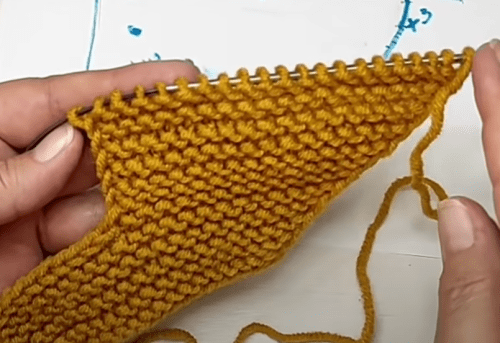
The increases shape the lower part of the piece.
Work 10 rows on the first 15 stitches
Continue working 10 rows with increases after the edge stitch, but only on the first 15 stitches.
In row 23, restore the bridge
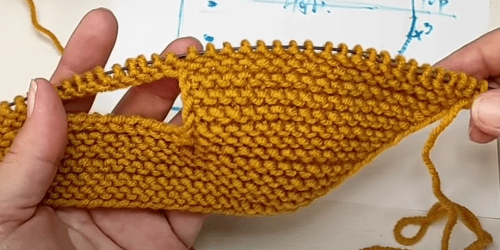
Row 23: knit 21 stitches, cast on 10 stitches, then knit 5 stitches from the first needle.
In row 23, the armhole bridge is restored by casting on 10 stitches.
Check the armhole shape
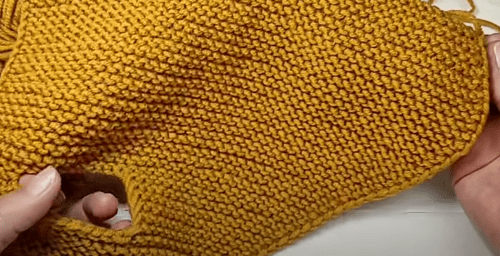
After this, the armhole should look like a triangular opening for the leg.
Check the armhole triangle
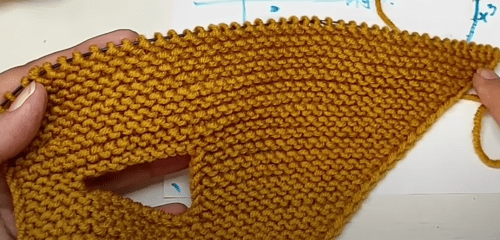
Compare the shape with the photo: the armhole is now complete, and you can continue knitting toward the middle section of the sweater.
The armhole shape after binding off and casting stitches back on.
Knit the Middle Back Section
Short rows are used in the front section so the sweater doesn't end up too wide at the neckline.
Place markers for the short rows
Mark the short-row positions with markers. They'll help you repeat the shape and later knit the second half as a mirror image.
Work rows 24 and 25
Row 24: knit all stitches except the last 5, leave them on the needle as a short row, and turn the work. Row 25: continue the increases after the edge stitch and knit all the stitches on the needle.
The main back section before knitting the second half as a mirror image.
Repeat the short row in rows 35 and 45
The source specifically notes to repeat the short row again in rows 35 and 45.
Change the increase frequency and finish the middle section
In row 40, the increases after the edge stitch are no longer worked in every knit row, but every 4th row, 4 more times. In row 52, the increases end, and you then knit 10 rows straight.
Knit the second half as a mirror image
Knit the second half of the sweater as a mirror image: work decreases instead of increases in the same places.
Don't lose your notes
The mirrored half depends on your notes about the increases and short rows.
Sew the Piece Together and Finish the Neckline
After the main piece is done, the bottom seam and the neckline should stay flat and stretchy.
Sew the bottom with a flat seam
Sew the finished piece along the bottom with a crochet hook or a blunt-tip needle to get a flat, even seam.
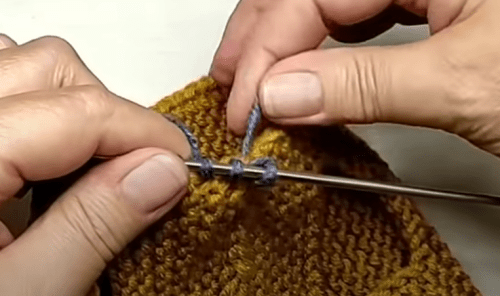
Pick up stitches around the neckline
Onto circular needles, pick up stitches from all the edge stitches around the neckline.
Neckline stitches are picked up from the edge stitches.
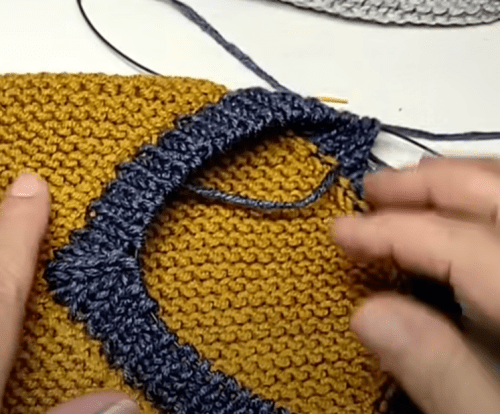
Knit the neckline ribbing
Work about 3-4 cm in 1x1 ribbing. It's best to bind off the edge with a needle so it stays stretchy.
The neckline after knitting 1x1 ribbing.
Work the Bottom Trim and Sleeves
The bottom ribbing evens out the edge. You don't have to knit the sleeves — leave them out and you'll have a vest.
Place markers for the bottom trim
From the bottom seam, mark off 20 edge stitches on each side and place the markers.
Pick up stitches for the bottom ribbing
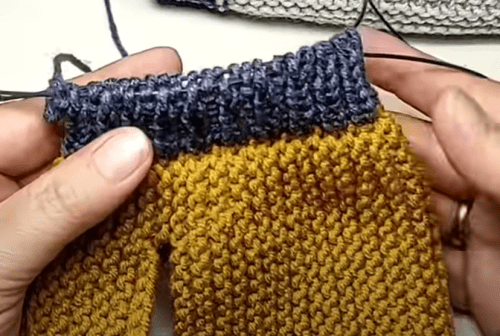
Between the markers, pick up a stitch from every edge stitch. From the seam to the marker, pick up with increases: the source says to add 4 stitches on each side.
The bottom ribbing is picked up from the edge stitches and finished near the bottom seam.
Knit and bind off the bottom trim
Work another 3-4 cm in 1x1 ribbing. Near the bottom seam, bind off 3 stitches together at a time, then bind off all the remaining stitches.
Decide whether you want sleeves
You can leave the armholes open, and you'll get a knitted vest for a dog. If you want sleeves, pick up stitches from the edge stitches using the same method, knit a tube, fold it, and sew it to the height you need.
Finish and variations
Finish
Check the fit on the dog
The sweater should cover the back to the length you need, without pressing on the chest or neck, and without getting in the way of the front legs.
Check the seams and ribbing
The bottom seam should be flat, the neckline stretchy, and the bottom trim shouldn't pull in the center of the piece.
Variations
Vest without sleeves
If you leave the armholes open, you'll get a knitted vest for a dog.
Sweater with short sleeves
Around the armholes, you can pick up stitches from the edge stitches, knit a tube, fold it, and sew it to the height you need.
The finished piece is too small or too big for the dog.
Likely cause
The example sizes were used without checking them against your own pet's measurements.
How to fix it
First take L, C, N, and G yourself. The measurements 30 cm, 30-32 cm, 20-25 cm, and 10-12 cm in the source apply to the small dog in the example.
The second half doesn't match the first
Problem
When knitting the mirror image, the shape drifts off.
Likely cause
The locations of increases, decreases, and short rows weren't written down.
How to fix it
Keep a notebook with the rows. In the second half, work decreases in the same places where the first half had increases.
The armhole comes out the wrong shape
Problem
The leg opening doesn't look like a triangle.
Likely cause
The armhole was started on the wrong row, or the bind-off/cast-on of 10 stitches wasn't done correctly.
How to fix it
Start the opening on a purl row. In row 10, knit 5 stitches, bind off 10 stitches, knit 15 stitches; in row 23, cast on 10 stitches again.
The neckline is too wide
Problem
The sweater doesn't sit close to the neck.
Likely cause
The short rows in the front section were skipped.
How to fix it
Don't skip the short rows: row 24 with 5 stitches left unworked, plus the repeats in rows 35 and 45, keep the sweater from widening at the neckline.
The neckline doesn't stretch well
Problem
The neckline edge is too tight around the neck or doesn't fit over the head easily.
Likely cause
The edge was bound off too tightly.
How to fix it
After the 3-4 cm of 1x1 ribbing, bind off the stitches with a needle to get a stretchy edge.
The bottom trim puckers the seam
Problem
The edge near the bottom seam gathers or sticks out.
Likely cause
Stitches weren't added from the seam to the markers, or stitches weren't bound off together near the seam.
How to fix it
From the seam to the marker, add 4 stitches on each side, and when binding off near the bottom seam, bind off 3 stitches together at a time, as the source specifies.
?FAQ
What size dog is the example designed for?
The source gives an example for a small dog: length 30 cm, chest circumference 30-32 cm, neck circumference 20-25 cm, gap between the front legs 10-12 cm.
What yarn and tools do I need?
The source specifies Alize Lana Gold, 100 g, thread of the same thickness for trim, 30 g, size 4 needles, and a blunt-tip needle or crochet hook for the seam.
Is this tutorial suitable for beginners?
The source rates this as intermediate difficulty: you need to carefully track the rows, increases, short rows, and the mirrored decreases on the second half.
Where does the knitting start?
The knitting starts from the lower center section: cast on an extra row of 25 stitches and knit it in knit stitches, but this row isn't counted.
How is the armhole for the leg shaped?
In row 10, knit 5 stitches, bind off 10 stitches, and knit 15 stitches. After 10 rows worked on the first 15 stitches, in row 23, cast on 10 stitches again.
Why are short rows needed?
Short rows are worked in the front section so the sweater doesn't end up too wide at the neckline. The source specifies row 24 and repeats in rows 35 and 45.
How do I knit the neckline?
Pick up stitches from all the edge stitches around the neckline onto circular needles, knit 3-4 cm of 1x1 ribbing, and bind off the stitches with a needle for a stretchy edge.
Can I make a vest instead of a sweater?
Yes. The source says outright that you don't have to make the sleeves and can leave the armholes open: that gives you a knitted vest for a dog.
Your project
Log in to track your project, attach photos, and publish your result into the shared feed.
I knitted mine a bit differently, with a closure on the back. It's easier to put on lively little dogs that way, but I remember struggling without a pattern. Wish I'd had such a detailed tutorial back then.

 IntermediateFree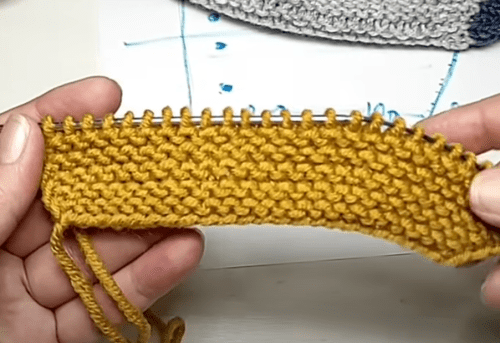


I knitted mine a bit differently, with a closure on the back. It's easier to put on lively little dogs that way, but I remember struggling without a pattern. Wish I'd had such a detailed tutorial back then.