Dog Hat Knitting Pattern: Measurements and 2 Simple Designs
A guide to choosing the right hat style for small and short-haired dogs, taking measurements, and knitting two basic designs: a simple tube hat and an ear-hole hat.
BeginnerFree
Translated
Things you will learn
The hat must not squeeze the head, press the ears, or snag the fur with fasteners.
A basic hat requires a head circumference measurement; styles with a collar or ear holes also need the ear-to-ear distance and neck circumference.
Before calculating stitch counts, knit and wash a swatch — it shows the actual gauge and how much the yarn shrinks.
The simplest option for beginners is the tube hat; the ear-hole style requires more precise measurements and careful fitting around the ears.
What You'll Make
You'll end up with a soft knitted hat that covers your dog's head and, if needed, neck too. The tutorial covers two approaches: a simple tube for a calm dog, and an ear-hole hat that's easier to fit on an active pet.
Materials and tools
Materials
Soft yarn for the hat, Choose a natural or blended fiber without stiff strands or harsh dyes.
Optional embellishments, Pom-poms, ear shapes, or small decorative elements should only be added after checking the fit.
Ties or buttons if fastening is needed, Avoid hook-and-loop tape for long-haired dogs — it snags the coat.
Test swatch, 1 pc., Needed to calculate gauge and check shrinkage after washing.
Tools
Circular or double-pointed knitting needles, Choose a size to suit your yarn and desired fabric density.
Tape measure, Needed for head circumference, ear-to-ear distance, and neck circumference.
Tapestry needle or crochet hook for seaming, Required if you knit flat instead of in the round.
Cable needle, Only needed for the cable-pattern version.
Choose a style that suits your dog, not just what looks cute in photos
A simple tube hat works well for a calm dog. If your pet moves its ears actively or dislikes a closed fit, ear holes or a bonnet with extra room around the ears is a better choice. Small, short-haired, and low-to-the-ground dogs tend to feel the cold most, but even a warm hat must not press.
Check the yarn for softness
Dogs can react to rough synthetics and dyes with itching or skin redness. Before you start knitting, hold a swatch against your pet's skin briefly to make sure the fabric doesn't scratch.
Knit a swatch and recalculate the stitch count
Even if the tutorial gives you ready-made numbers, they only apply to a specific dog and a specific yarn. Knit a 2×2 rib swatch, stretch it slightly, measure the gauge, and then calculate your cast-on row.
Choose a Hat Style
First, decide how much of your dog's head, ears, and neck the hat needs to cover. This determines the shape, how many measurements you need, and how the hat will fasten.
Check the basic fit requirements
The hat must not be tight, press the ears, or rub the skin. For long-haired dogs, avoid hook-and-loop tape — it snags the fur and can irritate the dog. A better choice is a design without a fastener, or one with soft ties or buttons.
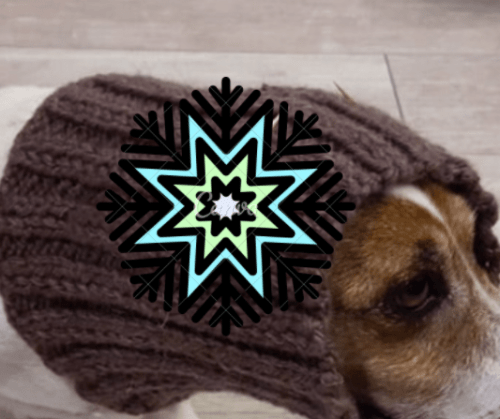
Example of a knitted hat covering the dog's head and upper neck.
Comfort check
After fitting, the dog should be able to turn its head freely, move its ears, and not immediately try to pull the hat off with its paws.
Compare the basic options
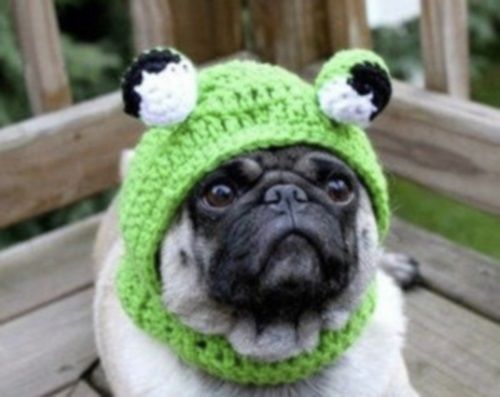
The tube hat is knitted in the round without seams and covers the head and neck. A hat with ear bumps or ear holes is more comfortable for small dogs because it doesn't press against the ear cartilage. A bonnet covers more of the neck and upper body. The decorative frog hat in the example suits French Bulldogs, English Bulldogs, Pugs, and similar breeds, but still needs to be fitted properly.
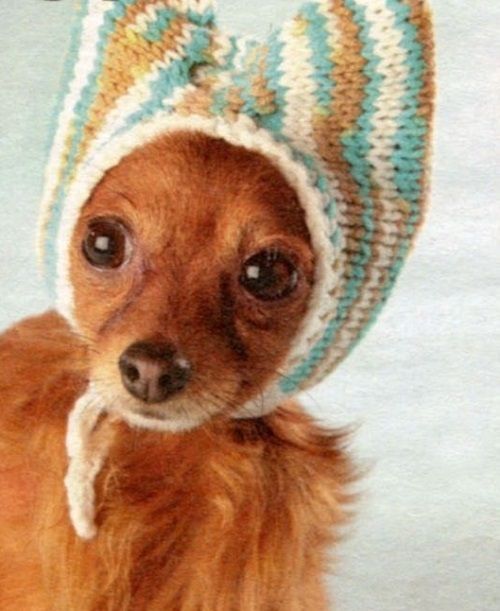
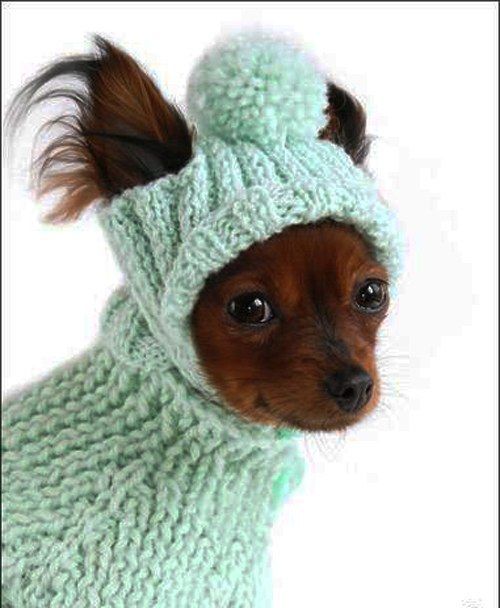
A tube hat covers the head and neck but requires careful fitting around the ears.A hat with ties suits small dogs as long as the ties don't press or tangle in the fur.A bonnet covers the head and neck; ear holes allow the ears to move freely.Decorative styles can inspire shape ideas, but fit still needs to be comfortable.
Discussion tip
If your dog moves its ears a lot, consider making proper openings or a bonnet with snug ruffles around the ears instead of bulky knitted ear shapes. The hat is less of a nuisance to the dog and still keeps it warm.
Take Measurements
For a simple tube you only need the head circumference. For ear-hole and collar styles it's better to take three measurements.
Measure the head circumference
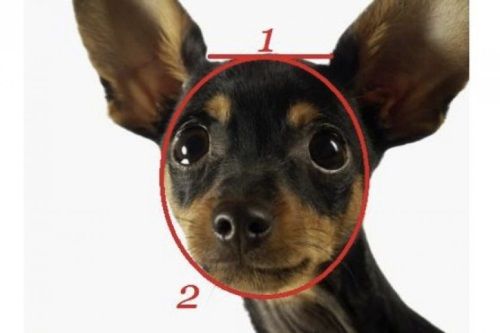
Run the tape measure under the muzzle, going around in front of the ears. This is the HC measurement — it determines the stitch count for the cast-on row.
Head circumference in front of the ears is the key measurement for calculating your cast-on.
Add ear-to-ear distance and neck circumference
Ear-to-ear distance is needed for styles with ear holes. Neck circumference is measured at the widest point: it's important for a balaclava-style hat, a bonnet, or a long tube that covers the neck.
Don't copy ready-made numbers without recalculating
The calculations in the example are for a small dog. For a different breed the stitch count, the width of the ear zone, and the height of the fabric will all change.
Knit the Simple Tube Hat
This is the most accessible option for beginners: the fabric is knitted in rib stitch to the head circumference and covers the head and neck.
Calculate the cast-on row
Knit a 2×2 rib swatch, stretch it slightly, and measure how many stitches fit in 1 cm. Multiply the gauge by your dog's head circumference — that gives you the approximate number of stitches to cast on.
Wool may shrink
If you're using pure wool, wash and dry the swatch before doing your calculations. The hat will be exposed to snow, rain, and frequent washing, so it's better to check shrinkage in advance.
Knit the tube to the right length
Knit in the round on circular or double-pointed knitting needles. If you prefer knitting flat, once the fabric is the right length, seam it with a flat stitch using a tapestry needle or crochet hook. The length should cover the head and neck and reach a little over the chest.
A simple tube: the fabric covers the head and neck with no separate ear openings.
Try it on before adding any decoration
Check the fit first: the hat should not slide off but should not press on the head either. Only attach ear bumps, pom-poms, or other embellishments after a successful fitting.
Knit the Ear-Hole Hat
This design is more involved because the crown and the neckband are made separately, and the ear openings need to be placed precisely according to your measurements.
Start with the front panel
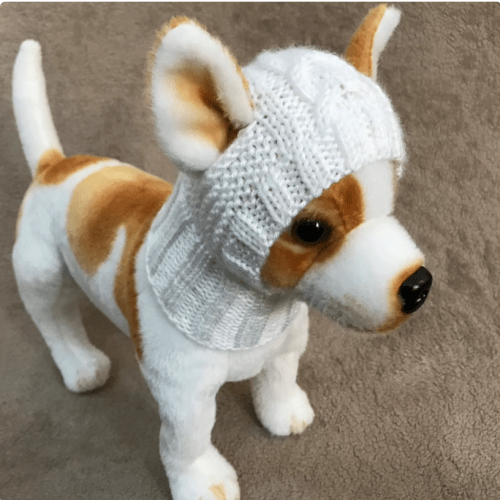
For the small dog in the example — a Chihuahua — cast on 50 stitches and work 2×2 rib for about 3–4 cm. Then divide the fabric into three sections: the center section equals the ear-to-ear distance — 16 stitches — with 17 knit stitches on each side.
The ear-hole style requires precise ear-to-ear measurement; the photo was included as an Etsy example.
The sample numbers are not universal
50 stitches, 16 stitches in the center, 17 stitches on each side, and 7 stitches for the ear openings apply only to the specific small model used as an example. For your own dog, recalculate all figures using your measurements and swatch.
Work the side panels and the center cable pattern
Row 1 and all odd rows: 17 knit stitches, 16 stitches in cable pattern (2 knit, 2 purl, 8 knit, 2 purl, 2 knit), 17 knit stitches.
Row 2 and all even rows: work the side panels in knit stitch, work the center panel in pattern (knit the knits, purl the purls).
Row 7: 17 knit, 2 knit, 2 purl, slip 2 stitches to a cable needle and hold in front, knit 2 then knit the 2 from the cable needle. Then slip 2 knit stitches to a cable needle and hold in back, knit 2 then knit the 2 from the cable needle, 2 purl, 2 knit, 17 knit stitches of the side panel. This creates two crossing cables in the center section.
Form the ear openings
On row 19 of the pattern, knit 10 stitches, bind off 7 stitches, work the center section in pattern, bind off 7 more stitches, and knit the final 10 stitches. On row 20, cast on 7 new stitches over each bound-off gap to continue the fabric.
Finish the hat and knit the neckband
Continue in garter stitch with the center cable pattern until you reach the base of the neck, then work the back seam. Pick up 48 stitches along the bottom edge of the hat onto circular needles and knit a 2×2 rib neckband 7 cm tall. Bind off all stitches with a tapestry needle to keep the edge stretchy.
Check the Fit and Care for the Hat
A finished hat should be evaluated not just from photos but in motion — the dog should be able to walk, sniff, and turn its head comfortably.
Try the hat while the dog is moving
Put the hat on at home for a short session. If the dog moves around calmly and the fabric doesn't slide over its eyes or press on its ears, you're ready for outdoor walks.
Dry and wash the hat gently
After wet snow or rain, dry the hat flat. If the yarn is natural fiber, wash in lukewarm water without sudden temperature changes so the fabric doesn't shrink.
Finish and variations
Finish
Final check
Before a walk, make sure the hat doesn't cover the dog's eyes, doesn't press on the ears, and doesn't get in the way of the leash or collar. If the dog tries to remove the hat, shorten the wearing sessions and introduce it gradually.
Variations
Bonnet or balaclava
If you need more warmth, you can knit a bonnet or balaclava that covers the neck. Neck circumference and a stretchy edge are especially important for this style.
Decorative finishing
Pom-poms, ear shapes, or playful elements are added at the end. They must not weigh the hat down, block the dog's vision, or irritate it.
The dog is restless, shakes its head, or tries to pull the hat off.
Likely cause
The ear openings are not positioned to the correct measurements, or the crown section is knitted too tightly.
How to fix it
Check the ear-to-ear distance and the width of the openings. For an active dog, make the openings slightly larger or switch to a bonnet or tube hat that doesn't press against the ear cartilage.
The hat turned out too tight
Problem
The fabric presses on the head or is difficult to put on.
Likely cause
The gauge was calculated without stretching the rib, or the edge was bound off too tightly.
How to fix it
Recalculate the stitches using a 2×2 rib swatch measured in a slightly stretched state. Bind off the bottom edge and neckband using a stretchy method.
The yarn irritates the skin
Problem
After fitting, the dog scratches or the skin becomes red.
Likely cause
The yarn is scratchy, contains stiff synthetic fibers, or harsh dyes.
How to fix it
Use a softer natural or baby yarn. Before starting a new hat, test a small swatch in contact with your pet's skin.
The fastener catches the fur
Problem
Long fur gets stuck in the fastener and the dog becomes anxious when the hat is removed.
Likely cause
Hook-and-loop tape was used on a fluffy dog.
How to fix it
Replace hook-and-loop tape with ties, buttons, or a fastener-free design. This reduces the risk of pulling out fur.
?FAQ
Can this hat be made for any breed?
Yes, but you cannot copy the numbers from the example directly: 50 stitches and the 17+16+17 layout are for a small dog. For every breed you need to take measurements and recalculate the stitches using your own gauge.
Are ear holes required?
No. If your dog is comfortable wearing a tube or a bonnet, ear holes aren't necessary. But if the ears are large or the dog moves them a lot, openings often make the fit more comfortable.
Can this hat be crocheted instead?
Yes. The principle is the same: take measurements, make a swatch, calculate the gauge, and check the fit. The main calculations in this tutorial are given for knitting needles.
What yarn should I use?
Choose a soft yarn that doesn't scratch and doesn't irritate the skin. For sensitive dogs it's best to avoid stiff synthetics and strongly colored yarn with harsh dyes.
Your project
Log in to track your project, attach photos, and publish your result into the shared feed.
Such adorable designs) But how will the dog move its ears? Or should those ear parts be knitted with extra room? I once saw a knitted bonnet on a dog with two rows of ruffles along the top. The ears stuck out between the ruffles. It looked very funny, but I imagine the ruffles still kept the ears warm. They were quite firm and didn't droop. The height of the ruffles was just a bit taller than the dog's ears. There were obviously openings in the hat for the ears. That's a much easier style to knit than actual ear shapes, and more comfortable for the dog too. Although, if you start early, maybe the dog will get used to wearing a hat with ear bumps as well.
Such adorable designs) But how will the dog move its ears? Or should those ear parts be knitted with extra room? I once saw a knitted bonnet on a dog with two rows of ruffles along the top. The ears stuck out between the ruffles. It looked very funny, but I imagine the ruffles still kept the ears warm. They were quite firm and didn't droop. The height of the ruffles was just a bit taller than the dog's ears. There were obviously openings in the hat for the ears. That's a much easier style to knit than actual ear shShow full quoteCollapse
Such adorable designs) But how will the dog move its ears? Or should those ear parts be knitted with extra room? I once saw a knitted bonnet on a dog with two rows of ruffles along the top. The ears stuck out between the ruffles. It looked very funny, but I imagine the ruffles still kept the ears warm. They were quite firm and didn't droop. The height of the ruffles was just a bit taller than the dog's ears. There were obviously openings in the hat for the ears. That's a much easier style to knit than actual ear shapes, and more comfortable for the dog too. Although, if you start early, maybe the dog will get used to wearing a hat with ear bumps as well.
It all depends on whether it's a decorative hat or one that's actually meant to keep the ears warm. If the dog has frequent ear infections or is getting older, you have to protect against frost and wind as much as possible. And little ones who can't stand the cold at all do need hats with ear covers — though the size still needs to be right so there's no discomfort. My dog is a shepherd mix who buries his head in the snow in winter and runs through snowdrifts — he's perfectly happy without one, but I once knitted a hooded onesie for a friend's Bolognese.

 BeginnerFree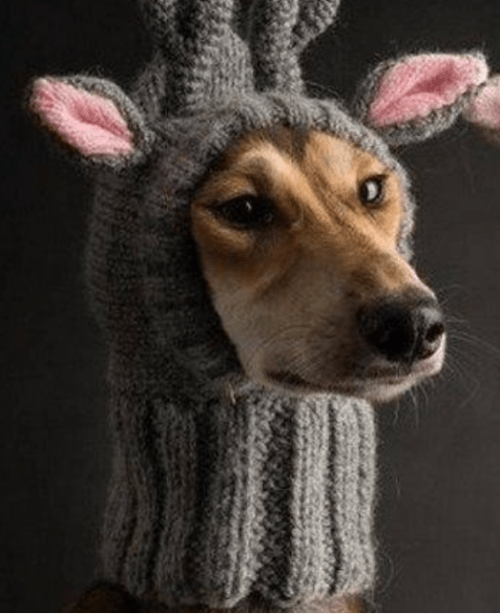


Such adorable designs) But how will the dog move its ears? Or should those ear parts be knitted with extra room? I once saw a knitted bonnet on a dog with two rows of ruffles along the top. The ears stuck out between the ruffles. It looked very funny, but I imagine the ruffles still kept the ears warm. They were quite firm and didn't droop. The height of the ruffles was just a bit taller than the dog's ears. There were obviously openings in the hat for the ears. That's a much easier style to knit than actual ear shShow full quoteCollapse