How to crochet a mesh market bag from cord or yarn: choose the material, calculate the sample at 20 stitches in the source example, make mesh cells from chains and treble crochet stitches, join two halves, add handles, and finish with tassels.
BeginnerFree
Translated
Things you will learn
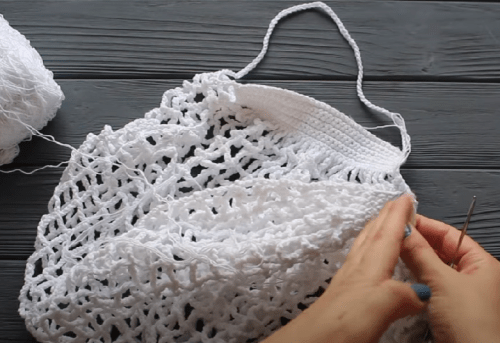
The bag is worked from the top down in two halves, then joined into one piece.
For the medium-size model, the source uses about 20 cm between the handles and 20 stitches for the firm middle section.
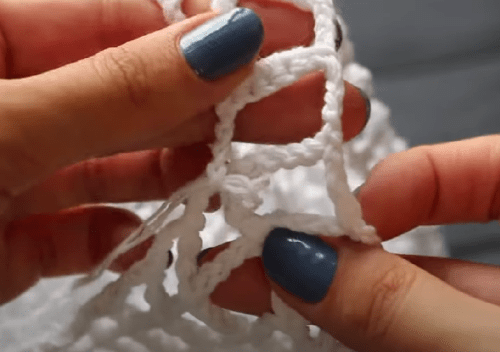
Large mesh cells are made with a 4-chain rise, a 4-chain span, and a treble crochet stitch worked into the next base stitch.
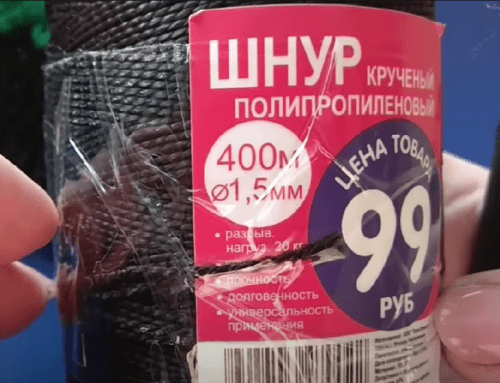
For grocery use, the author recommends jute yarn or cord. Fine synthetic yarn or tightly twisted cotton is better for a lighter bag.
What you will make
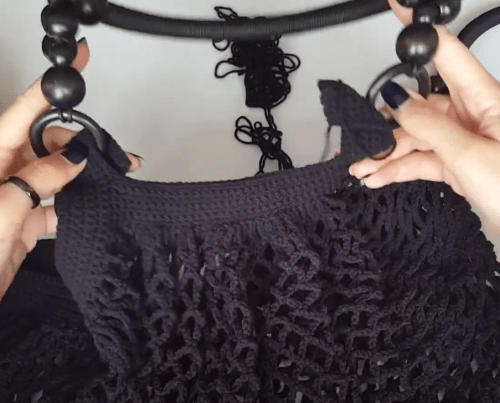
The finished piece is a mesh market bag: the firm upper section supports the handles, the open body stretches around the contents, the sides are gathered with single crochet, and decorative handles with tassels give it a more city-ready look.
Materials and tools
Materials
Yarn or cord for the market bag, For a light bag, use fine synthetic yarn or tightly twisted cotton; for groceries, use jute yarn or cord.
Strong nylon thread, Used to sew the loops for decorative handles securely.
Decorative handles or rings, Needed only for the decorative-handle version.
Tassels from the same yarn, Optional decoration for the finished bag.
Tools
Crochet hook, Choose the size for your yarn or cord; use a smaller hook if the firm upper section feels loose.
Measuring tape, For checking the distance between the handles and the final bag size.
Sewing needle, For sewing the handle loops with doubled nylon thread.
Files and resources
Video: round crochet market bag from cordIn the source, this is a separate detailed video tutorial for a round cord version.Video: round crochet market bag from cord
Preparation
Decide how the bag will be used
If the bag is not meant for heavy items, fine synthetic yarn or tightly twisted cotton can work. For grocery shopping, the author recommends jute yarn or cord.
Allow for stretching
Fine yarn and cotton can stretch with use, so choose a stronger material when the bag needs to carry heavier contents.
Material, size, and gauge
The size depends on the chosen yarn, your crochet tension, and the size of the mesh cells, so the author starts with a sample.
Choose yarn or cord
For a light city bag, use fine synthetic yarn or tightly twisted cotton. For groceries and several kilograms of weight, choose jute yarn or cord.
For a grocery bag, the author recommends jute yarn or cord.
Load depends on the material
Do not apply the “several kilograms” claim to fine yarn: in the source it refers to jute yarn or cord.
Set the width by the handles
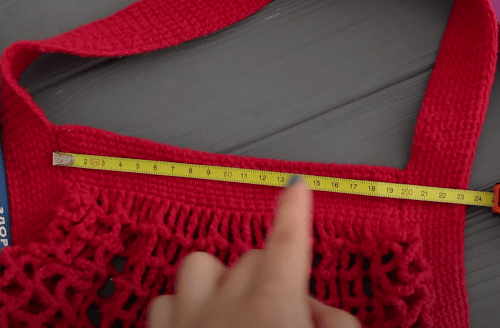
For a medium bag in not-too-thick yarn, aim for about 20 cm between the handles. A wider distance makes the rounded market bag wider and roomier.
For a medium size, the author uses about 20 cm between the handles.
Make a sample and calculate the stitches
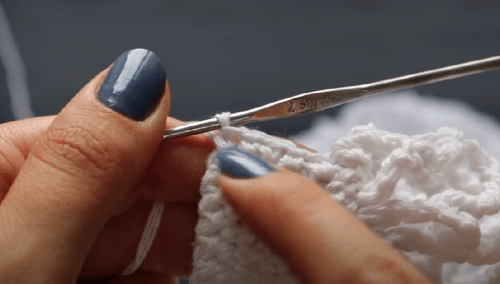
Crochet a single-crochet sample and calculate how many stitches you need for the firm middle section of the bag. In the author’s model, the count is 20 stitches.
Two halves and the mesh body
The bag is crocheted from the top down: first the firm handle area, then the open mesh.
Crochet the firm upper section
Chain the calculated number of stitches and work 4 cm straight, without increases or decreases. The handles will be attached here, so this fabric needs to be firm. If it feels loose, switch to a smaller hook.
Start the large mesh cells
Chain 4 for the rise, then chain 4 more for the horizontal span. Yarn over twice, insert the hook into the next base stitch, and work a treble crochet stitch.
A large cell is formed from the rise, the chain span, and a treble crochet stitch.
Repeat the cells to the end of the row
Repeat the pattern to the end of the row. Each time, work the treble crochet into the next base stitch and do not skip extra stitches.
Smaller openings
For smaller mesh cells, use double crochet stitches instead, and make the rise and span with 3 chains instead of 4.
Crochet the mesh to the needed length
Continue in the same pattern until the mesh reaches the length you want. The author gives an average of 15–18 mesh cells.
Make the second half
Finish the first half of the bag, then crochet the second half in the same way, but do not complete the last row of mesh cells on the second half.
Join the bottom and sides
At this stage the two halves become one piece, and the sides are gathered.
Join the left and right halves
Chain 4 for the rise, insert the hook into the first stitch of the second half, and work 4 single crochet stitches along the horizontal span. Chain 4 again and insert the hook into the other half of the bag. Continue joining the pieces while keeping the mesh pattern aligned.
After the halves are joined, the sides are gathered with single crochet.
Gather the sides
After the bottom is joined, gather the side sections by working 1 single crochet into each cell of the vertical row.
Work a firm edge along the side
Along the side section between the first 20 cm worked in single crochet, crochet a firm edge in single crochet.
Handles and finishing
The source gives two options: fully crocheted handles or decorative handles attached to crocheted loops.
Option 1: crochet the handles
If the handles will be crocheted, continue after edging the side and chain 80 more stitches. Insert the hook into the first side stitch, work a firm single-crochet edge, and make the second handle. Then work around this part of the bag in single crochet until the band is 4–5 cm wide.
Option 2: prepare loops for decorative handles
For decorative handles, after edging the side, work up through the middle section to the top and chain another 15 stitches.
A chain loop is crocheted for attaching the decorative handle.
Sew on the decorative handles
Turn the work and crochet back until you have a firm 4 cm-wide strip. Repeat on the second half. Fold the ends through the decorative handle rings, pin them from the wrong side, and sew them with doubled nylon thread.
The crocheted ends are folded through the handle rings and sewn from the wrong side.
Add tassels
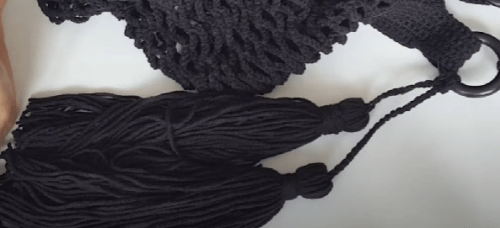
Decorate the finished bag with tassels made from the same yarn if you like.
The finished bag can be decorated with tassels from the same yarn.
Finish and variations
Finish
Check the handles and seams
Before using the bag, check the firmness of the upper section and the security of the sewn loops. The durability of the decorative handles depends on this seam.
Variations
Smaller mesh cells
For a less open mesh, use double crochet stitches and make both the rise and the span with 3 chains.
Inner drawstring pouch
If you do not want the contents to show through the mesh, add a removable drawstring pouch inside, made from linen or firm cotton.
Round cord version
The source ends with a video for crocheting a market bag in the round from cord. It is a separate construction, not the same two-half version.
Fine yarn or cotton was used for a load that needs a stronger material.
How to fix it
Use jute yarn or cord for grocery shopping. Keep fine yarn for a lighter bag.
The bag turned out too wide or too long
Problem
The finished bag does not match the medium size from the source.
Likely cause
The distance between the handles or the size of the mesh cells was not accounted for.
How to fix it
For a medium size, use about 20 cm between the handles. Remember that larger cells make the bag longer.
The firm handle area is too loose
Problem
The handle attachment area looks unreliable.
Likely cause
The hook is too large for the chosen material.
How to fix it
Crochet the upper section more tightly. The source suggests using a smaller hook when needed.
The mesh pattern goes off
Problem
The mesh looks skewed or has extra gaps.
Likely cause
The treble crochet stitches are not being worked into the next base stitch.
How to fix it
In every repeat, insert the hook into the next base stitch and do not skip extra stitches.
The contents show through the mesh
Problem
You do not want groceries or personal items visible through the large openings.
Likely cause
By design, the bag is an open mesh.
How to fix it
From the discussion: add a removable drawstring pouch inside, made from linen or firm cotton. It can be washed and made to match or contrast.
?FAQ
What should I use to crochet a market bag?
For a light bag, fine synthetic yarn or tightly twisted cotton can work. For grocery shopping, the author recommends jute yarn or cord.
How do I choose the size?
For a medium size in not-too-thick yarn, aim for about 20 cm between the handles. The wider that distance is, and the larger the mesh cells are, the roomier and longer the bag will become.
Where does the crochet start?
Start with a single-crochet sample and calculate the stitches for the firm middle section. In the author’s model, this is 20 stitches.
How are the large mesh cells made?
Make a 4-chain rise, chain 4 more for the span, then work a treble crochet stitch into the next base stitch.
What handle options are there?
There are two options: chain 80 stitches for crocheted handles and work them to a 4–5 cm width, or make 15-chain loops for decorative handles.
What if I do not want the contents to show?
The discussion suggests adding an inner drawstring pouch from linen or firm cotton. It can be washed and replaced.
Your project
Log in to track your project, attach photos, and publish your result into the shared feed.

 BeginnerFree